Weather Drops US January Oil Production

By Ovi

All of the Crude plus Condensate (C + C) production data for the US state charts comes from the EIAʼs Petroleum Supply monthly PSM which provides updated production information up to January 2025.

U.S. January oil production decreased by 410 kb/d to 13,246 kb/d and is down by 618 kb/d from October and was largely due to extreme late January weather. The largest decreases came from the Big 2 states, TX and NM. February’s production is expected to rebound by 450 kb/d to 13,696 kb/d according to the March STEO. Peak US oil production occurred in October 2025 at 13,864 kb/d but may be exceeded in early 2027.

According to this Article: U.S. would lose an average of 340 kb/d in January 2026 due to the cold weather. The 340 kb/d drop was a fairly good estimate since the combined January drop from Texas and new Mexico was 375 kb/d.

“Most of the remaining outages were in the Permian Basin in Texas and New Mexico, which accounts for around half of U.S. crude production, according to Energy Aspects analyst Jesse Jones, who said production there was recovering quickly.”

The dark blue graph, taken from the January 2025 STEO, is the U.S. oil production forecast from January 2026 to December 2027. Output for December 2027 is expected to drop to 13,844 kb/d. From February 2026 to December 2027 U.S. oil production is expected to increase by 148 kb/d.

The light blue graph is the STEO’s forecast for the Onshore L48 output to December 2027. From February 2026 to December 2027 production is expected to increase by 327 kb/d to 11,528 kb/d. The rising production starting in September 2026, according to the EIA, is due to higher prices for WTI and more NG pipelines being built. Note how production is essentially flat for all of 2027.

U.S. Oil Production Ranked by State
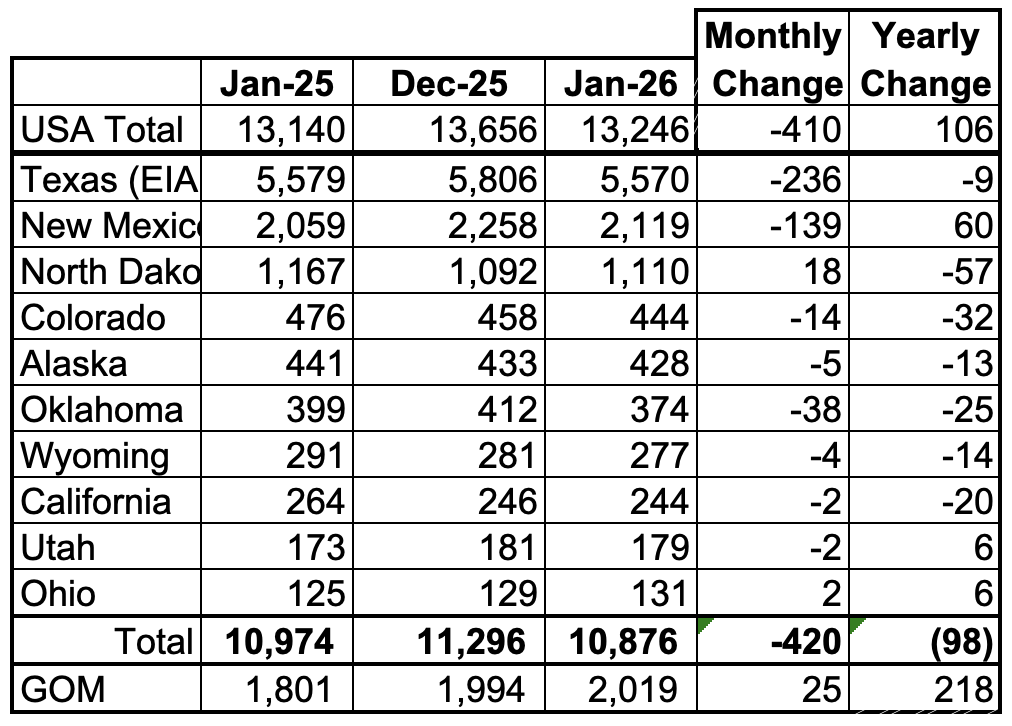
Listed above are the 10 US states with the largest oil production along with production from the Gulf of Mexico.

These 10 states accounted for 82.1% of all U.S. oil production out of a total production of 13,246 kb/d in January 2026. On a MoM basis, January oil production in these 10 states dropped by 420 kb/d. On a YoY basis, US overall production increased by 106 kb/d with the largest contributor being New Mexico and the largest decliner being North Dakota.

State Oil Production Charts
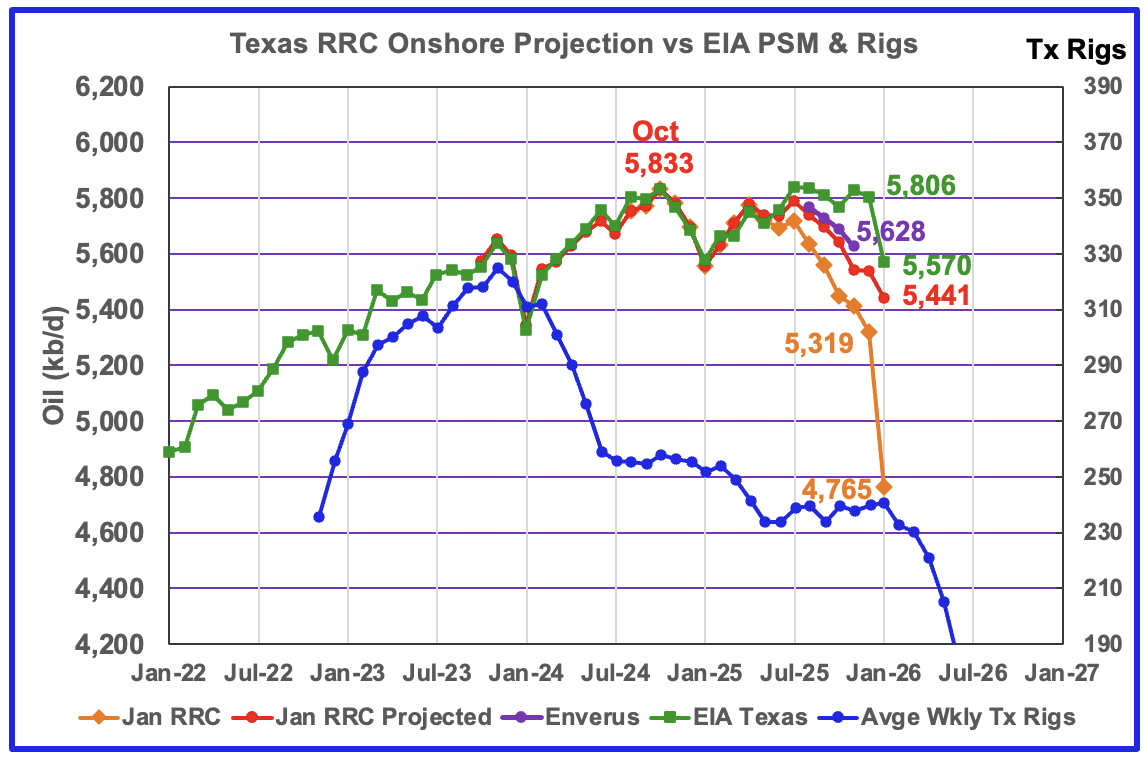
Texas’ January oil production decreased by 236 kb/d to 5,806 kb/d according to the EIA and is primarily due to extreme weather in late January.

The Texas’ RRC initial production for January dropped by 554 kb/d from December to 4,765 kb/d. The projection added 676 kb/d to raise January’s projected production to 5,441 kb/d. While the projection and the Enverus production estimate are showing declining production, the EIA’s Texas estimate shows production is in a plateau phase. It is not clear if this difference is due to late updating by the RRC. January’s projection is 129 kb/d lower than the EIA’s estimate and is 1/2 of the December gap 267 kb/d. The July 2025 gap between the projection and the EIA estimate is 51 kb/d and that gap will shrink over the next few months. Maybe the projection and Enverus estimate are too pessimistic.

The red graph is a production projection using the December and January Texas RRC data.

The blue graph shows the average number of weekly rigs reported for each month shifted forward by 10 months. So the 276 rigs operating in July 2023 have been shifted forward to May 2024. From February 2024 to July 2024, the rig count dropped from 312 in time shifted February 2024 to 256 in July 2024. That drop of 56 rigs had no impact on production up to July 2025. August 2025 appears to be the first month when the impact of the start of a flat rig count is resulting in essentially flat production. Will the rig count drop starting in time shifted February 2026 result in dropping Texas production going forward?
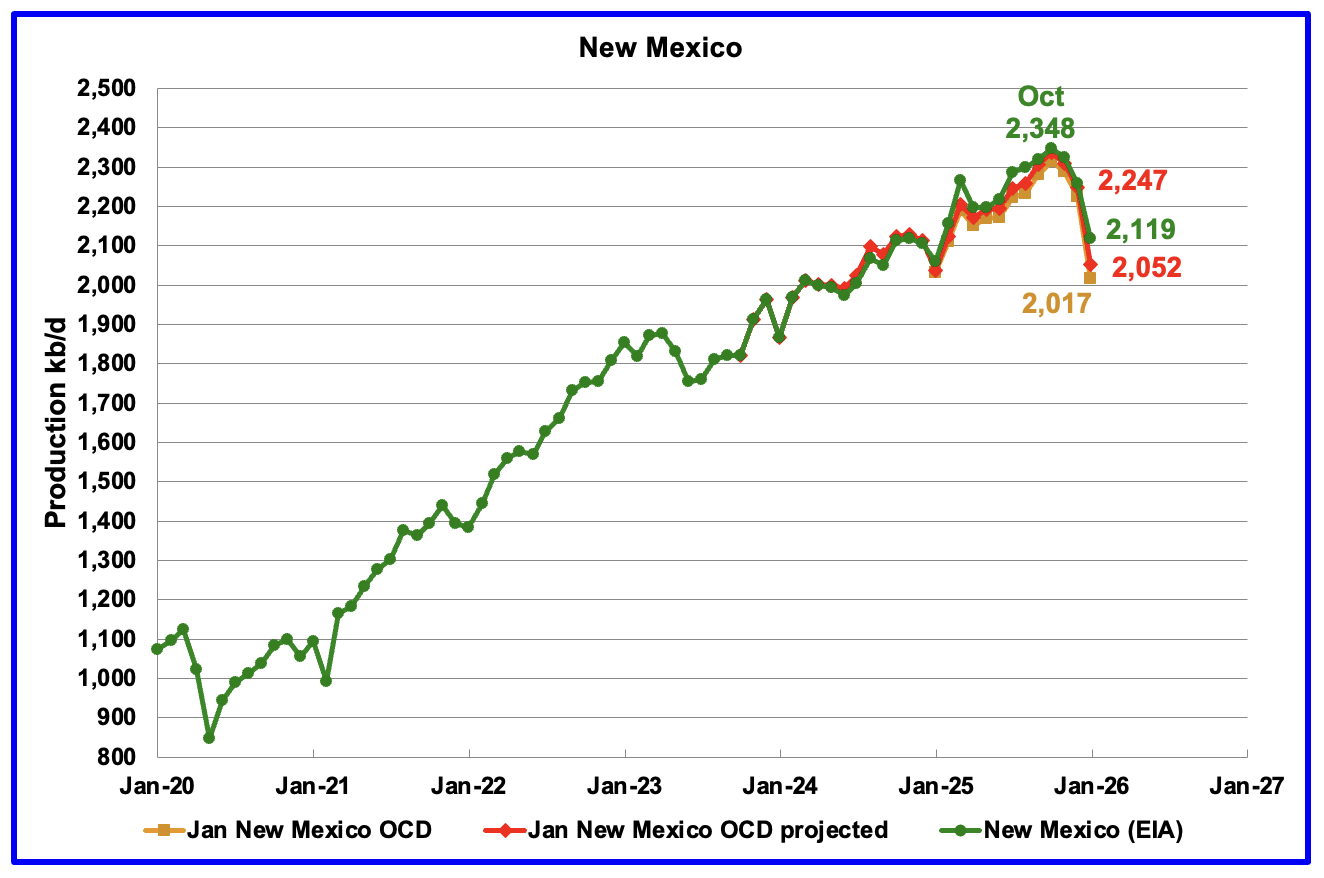
According to the EIA, New Mexico’s January production dropped by 139 kb/d to 2,119 kb/d. YoY production rose by 60 kb/d, the largest contributor to overall YoY rising US production.

The red graph shows the projected output up to January and is calculated using December and January NM OCD data. January’s projected production decreased by 195 kb/d from December to 2,052 kb/d and is 67 kb/d, 3%, lower than the EIA’s reported production. While the numbers are slightly different, the trend is the same.

The largest contributors to the 195 kb/d NM decrease came from Lea and Eddy Counties which dropped for a combined 202 kb/d. See Permian section further down.
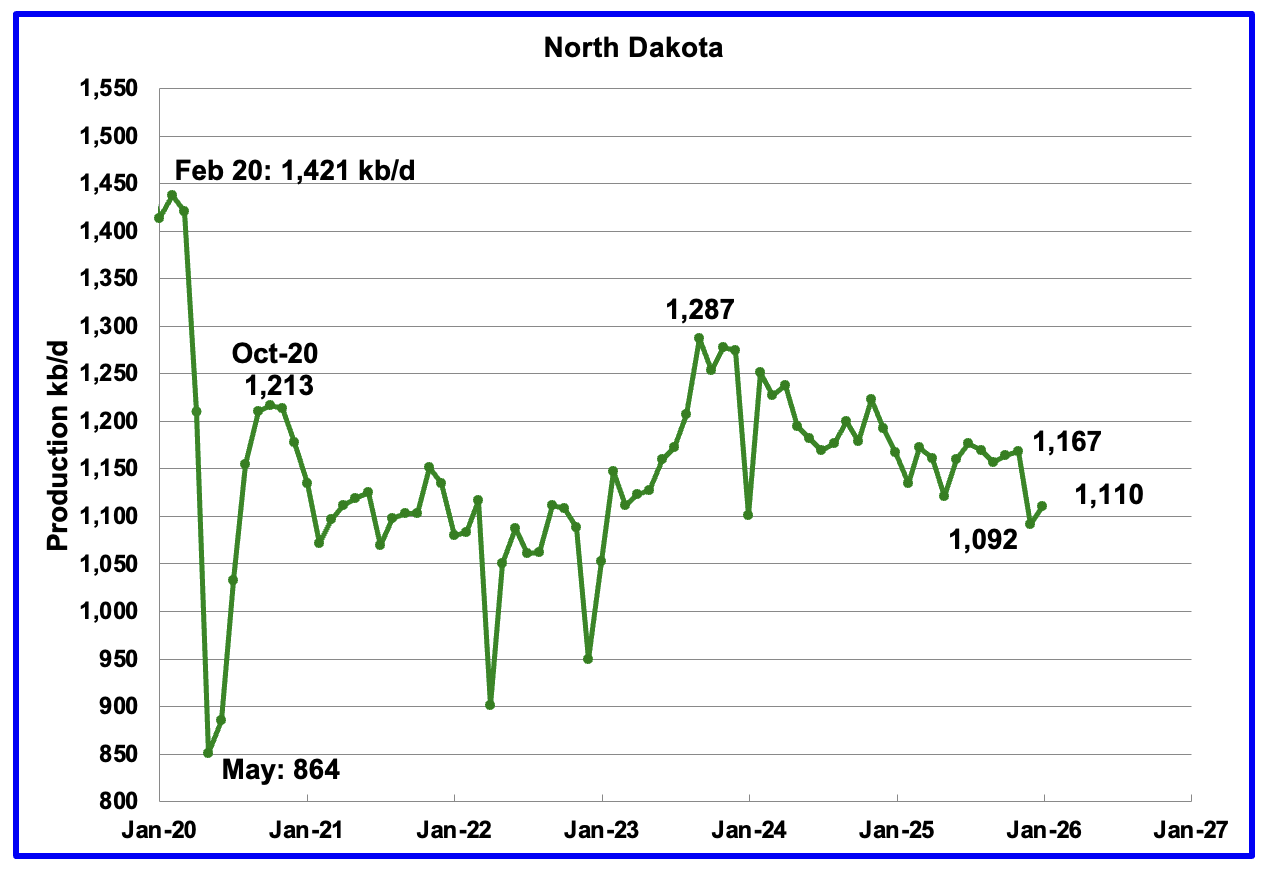
Production in North Dakota rose by 18 kb/d in January to 1,110 kb/d.

The North Dakota Department of Mineral resources reported January production decreased by 1 kb/d to 1,125 kb/d, which is 15 kb/d higher than the EIA’s estimate.

According to this Article, North Dakota operators likely to increase crude output in March.

“North Dakota crude output is expected to rise in March and the following months as operators in the third-largest oil-producing state restart inactive wells and winter restrictions are eased, the state’s regulator said on Thursday.

The North Dakota Department of Mineral Resources said, however, that the pace of activity would depend on how long oil prices stay high and that oil majors’ budgets have already been set.”
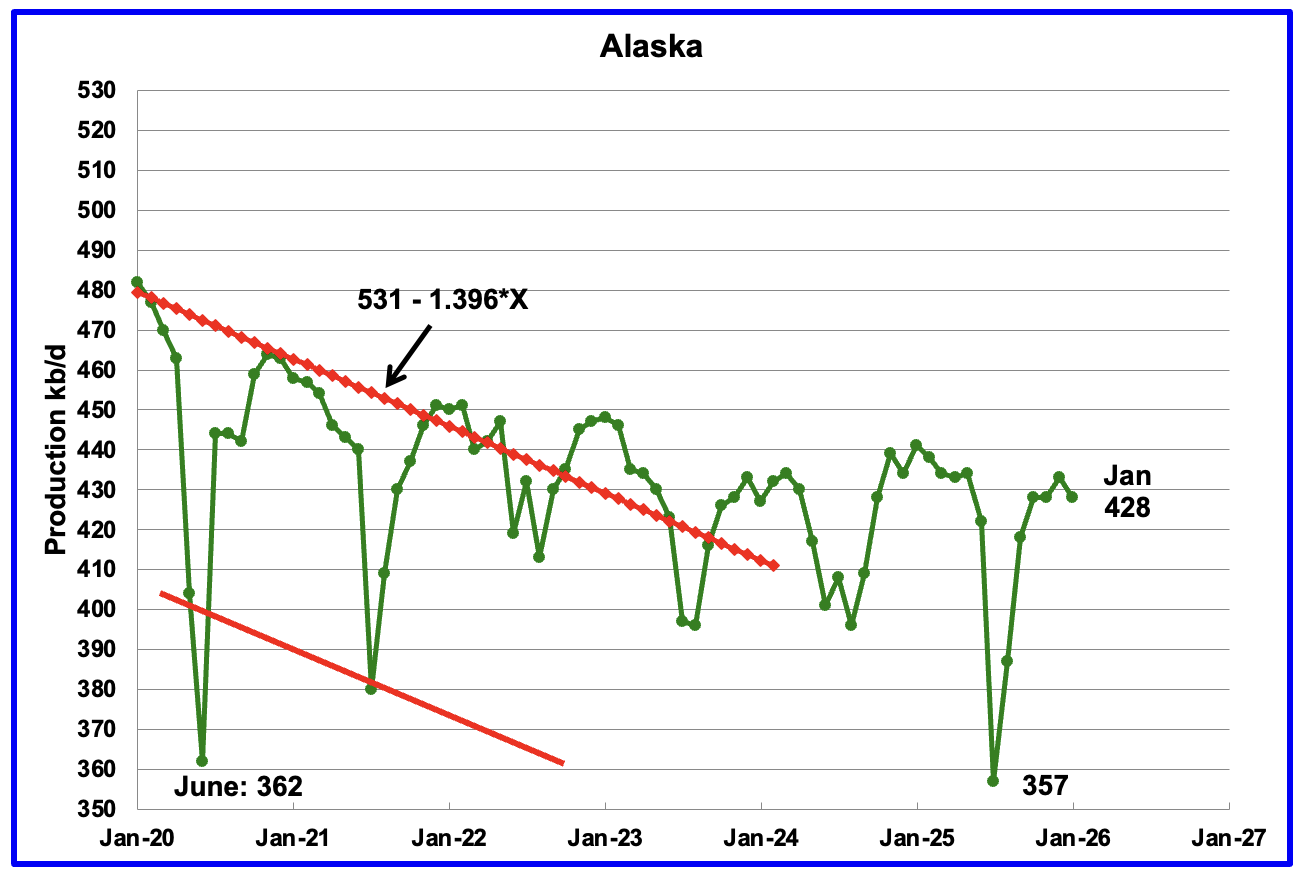
Alaskaʼs January output dropped by 5 kb/d to 428 kb/d while YoY production decreased by 13 kb/d. The EIA’s weekly reports indicated that January production would average close to 430 kb/d.

According to this Article, North Slope Oil Production Dips in January.

The 1% month-over-month decline in North Slope production was driven by decreases at several major fields, including Prudhoe Bay, Milne, and Colville River. However, the Greater Mooses Tooth field saw a major increase in output during the same period. Overall crude oil accounted for 89.06% of the 472,413 (420,727 C + C) barrels per day produced on the North Slope in January.

Alaska has recently brought new fields online to consistently have flat YoY and monthly production gains which have broken away from the earlier dropping production red trend lines. New production is expected to come online from the Picca field in early 2026.

Completion of the first phase of the Pikka oil field is on schedule with production start-up expected by the end of the first quarter, with the ramp-up to a plateau of 80,000 barrels per day anticipated in the second quarter, Santos executive Joe Balash told Petroleum News on Jan. 20.

The Alaska North Slope oil field is currently in the commissioning stage.
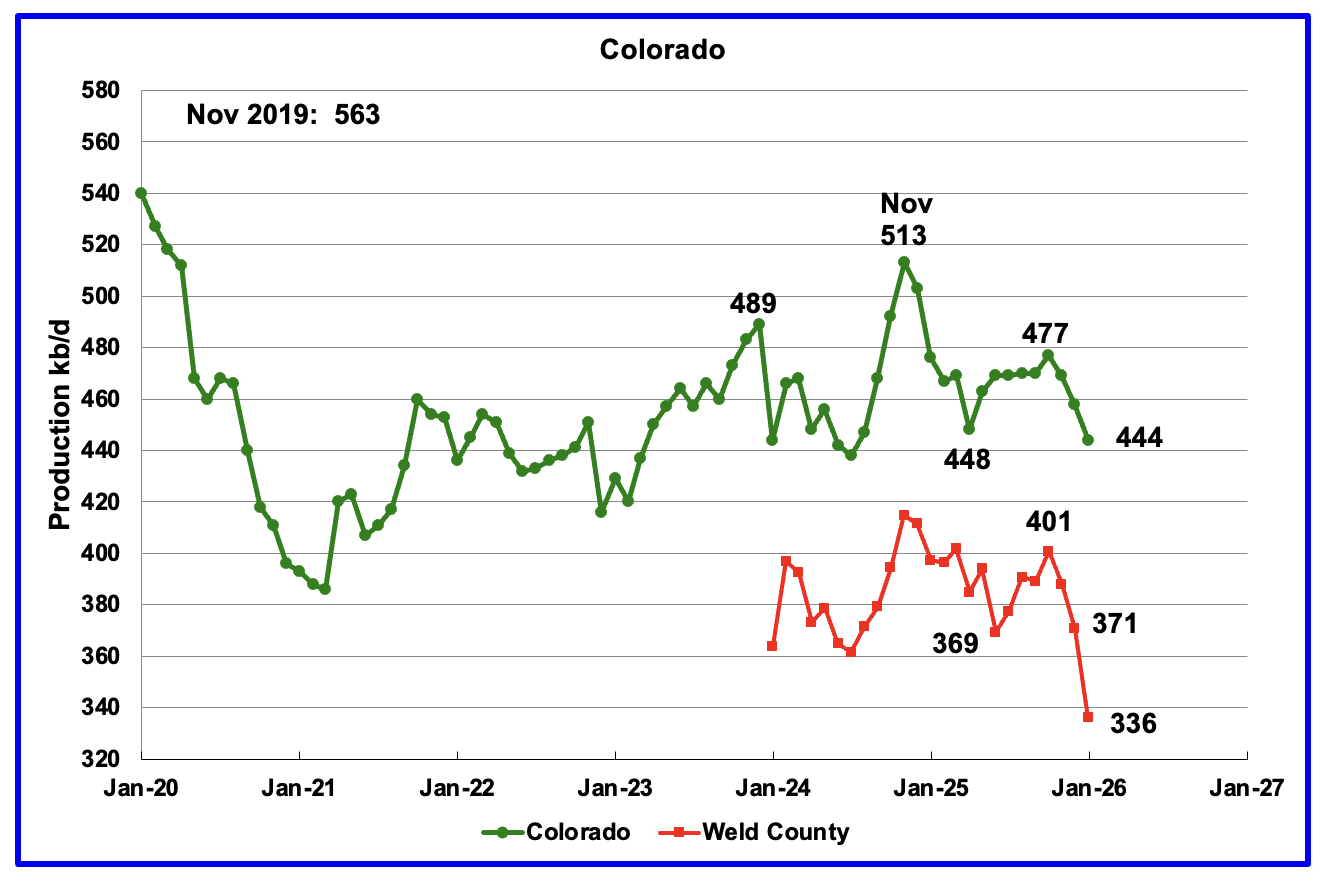
Coloradoʼs January oil production dropped by 14 kb/d to 444 kb/d.

The biggest oil producing county in Colorado is Weld County and its production has been added to the chart. The two graphs have been almost parallel over the last five months. Weld’s production dropped by 35 kb/d in January to 336 kb/d.

Colorado began 2025 with 6 rigs in January and February and peaked at 11 in October. At the end of March 2026 9 oil rigs were operational.
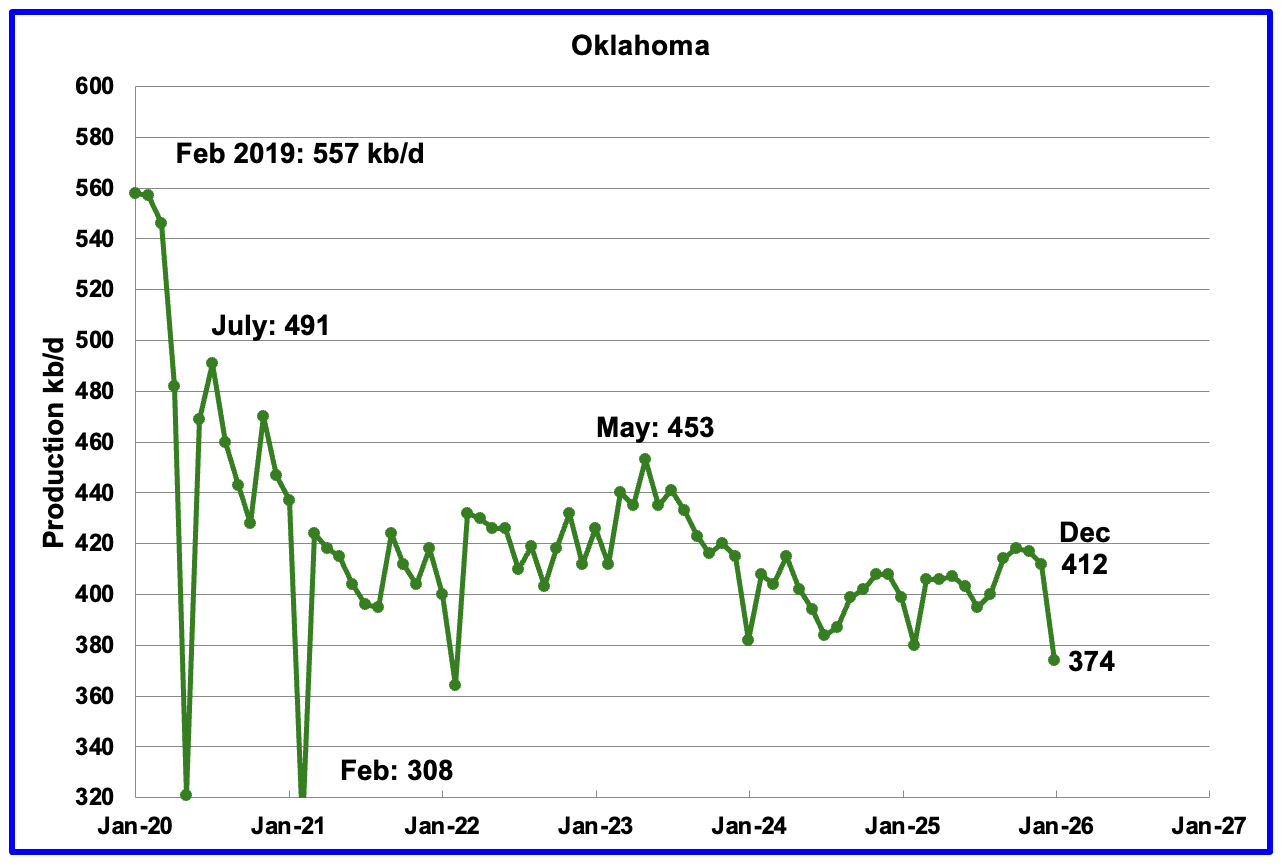
Oklahoma’s output in December dropped by 38 kb/d to 374 kb/d. Production remains below the post pandemic July 2020 high of 491 kb/d and is down by 79 kb/d since May 2023. Output entered a slow declining phase in June 2023 and now appears to be range bound around 400 kb/d ± 20 kb/d. The large drop out of the range may be due to the late January extreme weather.

Oklahoma had 51 operational rigs in May 2025 which slowly dropped to 41 rigs in July 2025. The rig count has been fairly steady around 40 from July 2025 to March 2026. The steady rig count since July may be showing up in the steady oil production around 400 kb/d.
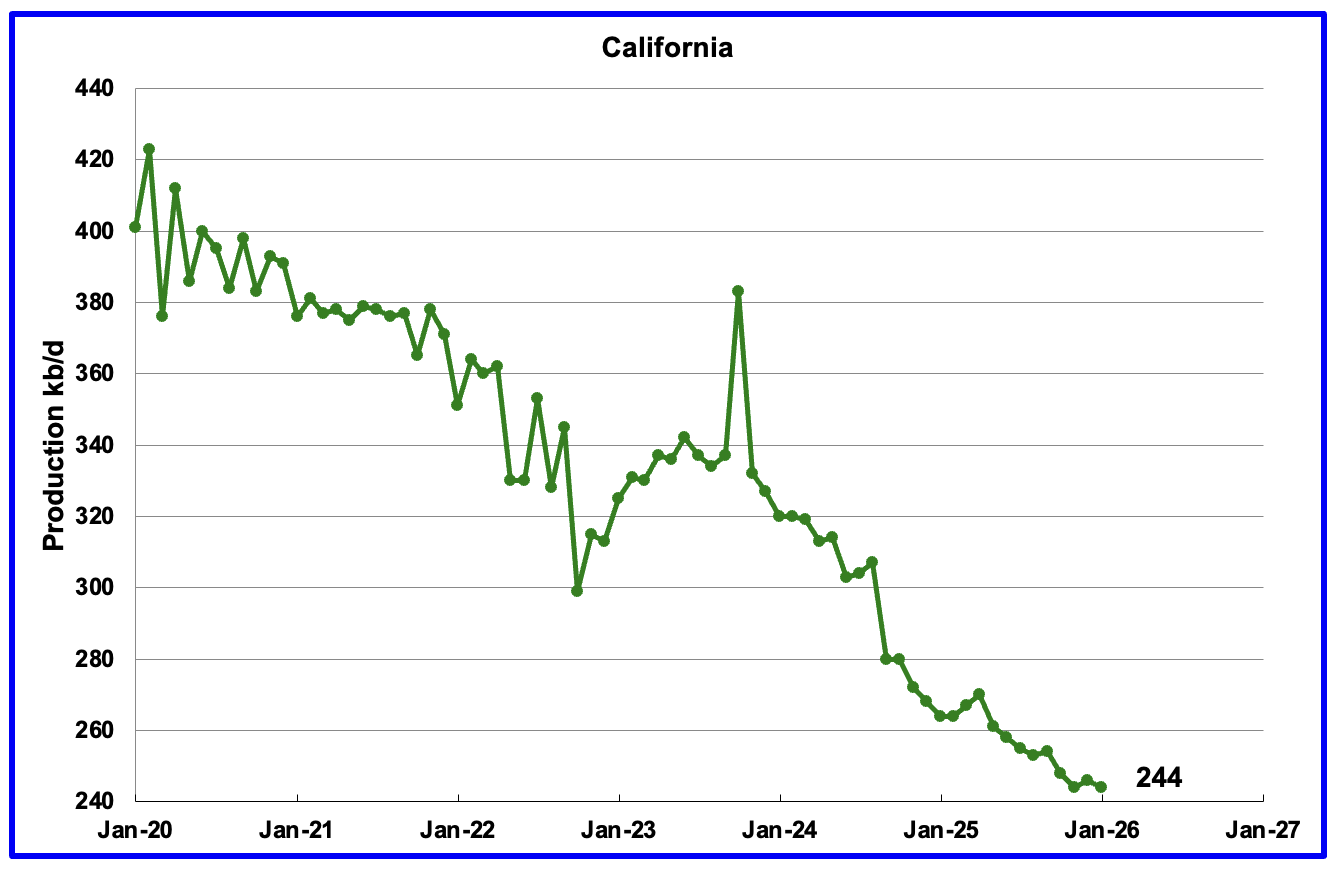
California’s overall declining production trend continues. January’s production dropped by 2 kb/d to 244 kb/d. YoY production dropped by 20 kb/d.
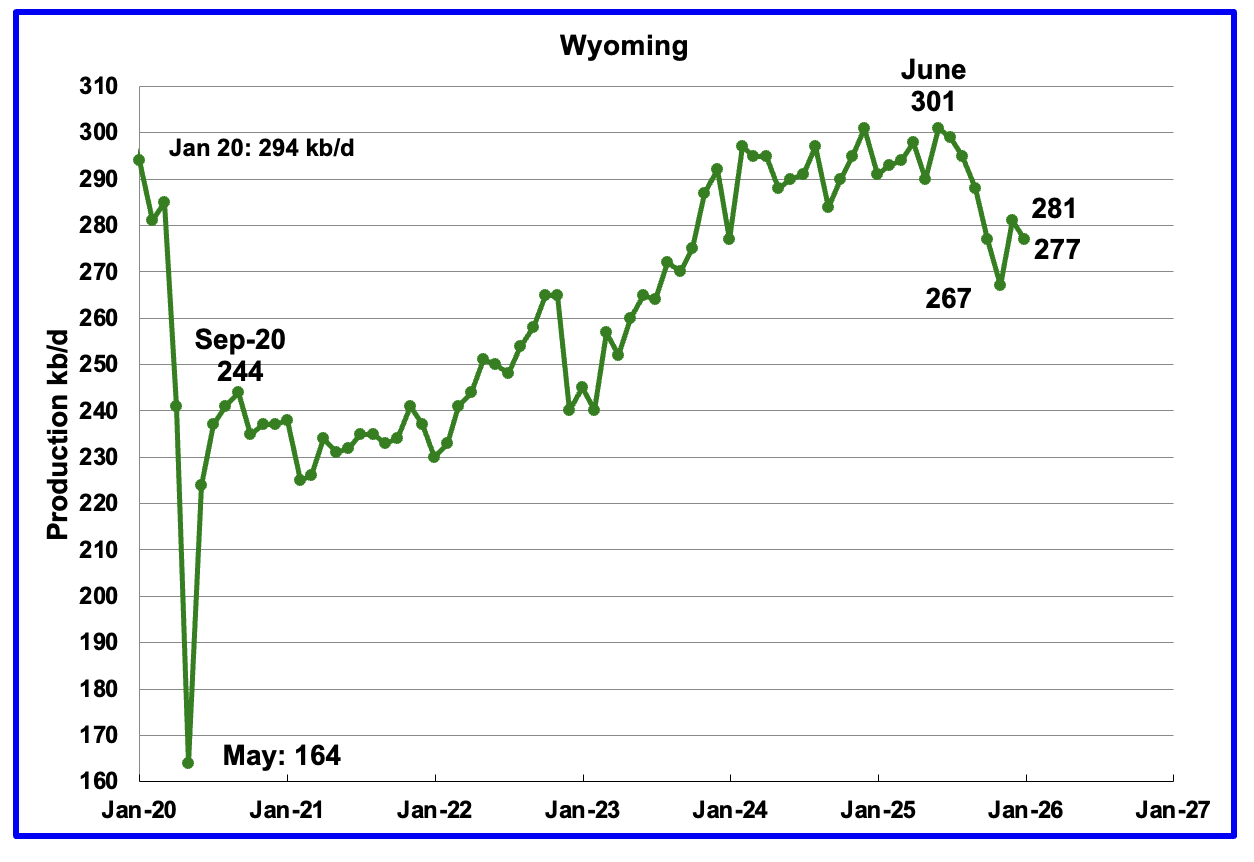
Wyoming’s oil production reached a post pandemic high in December 2024 and again in June 2025 of 301 kb/d. Production has dropped in each of the last 5 months before rebounding in December. January’s production dropped by 4 kb/d to 277 kb/d.

Wyoming dropped 1 rig in Early April a total of 13.
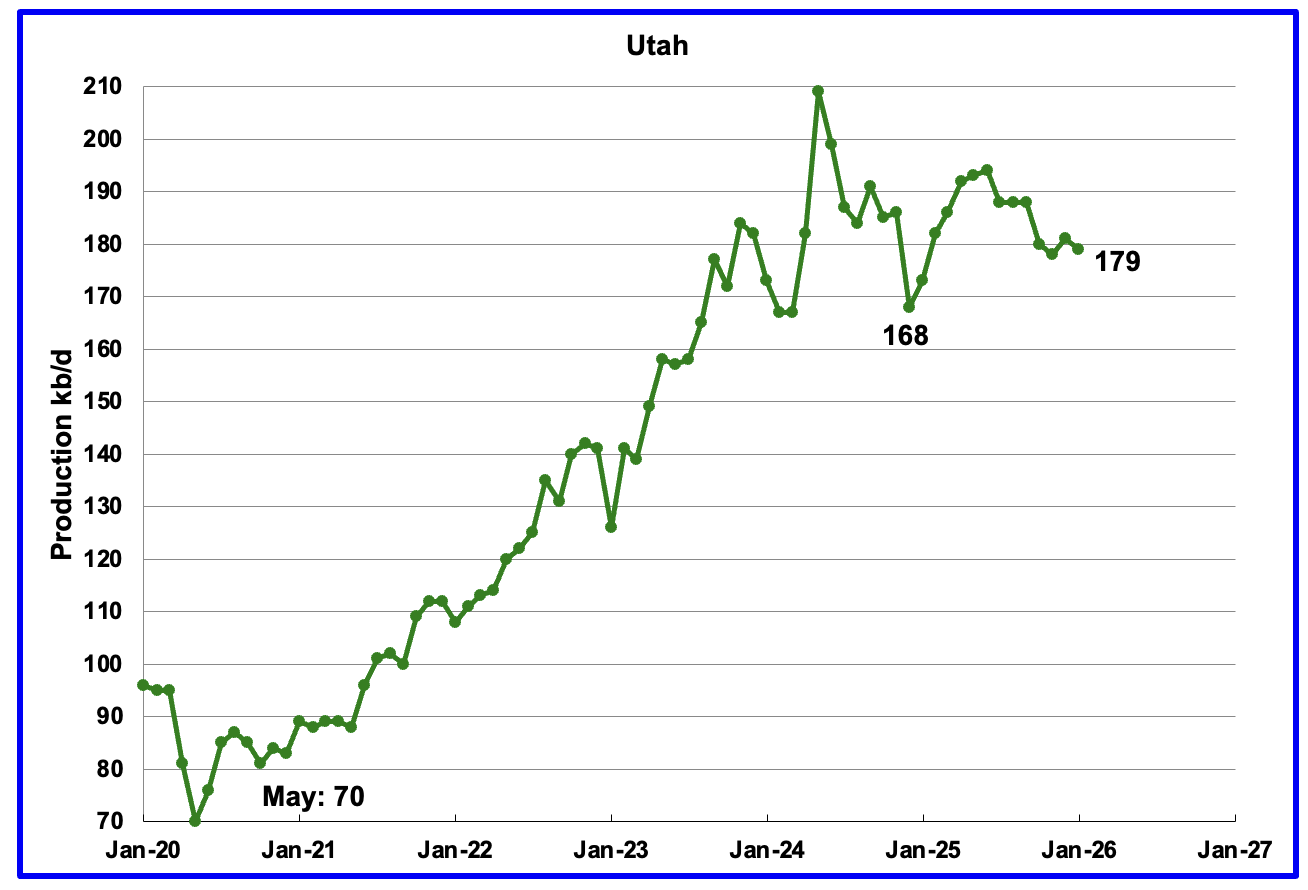
January’s production dropped by 2 kb/d to 179 kb/d. Utah had 8 rigs operating from October 2024 through May 2025 but dropped to 6 in early July 2025. By the beginning of April 2026 the rig count had risen to ten.
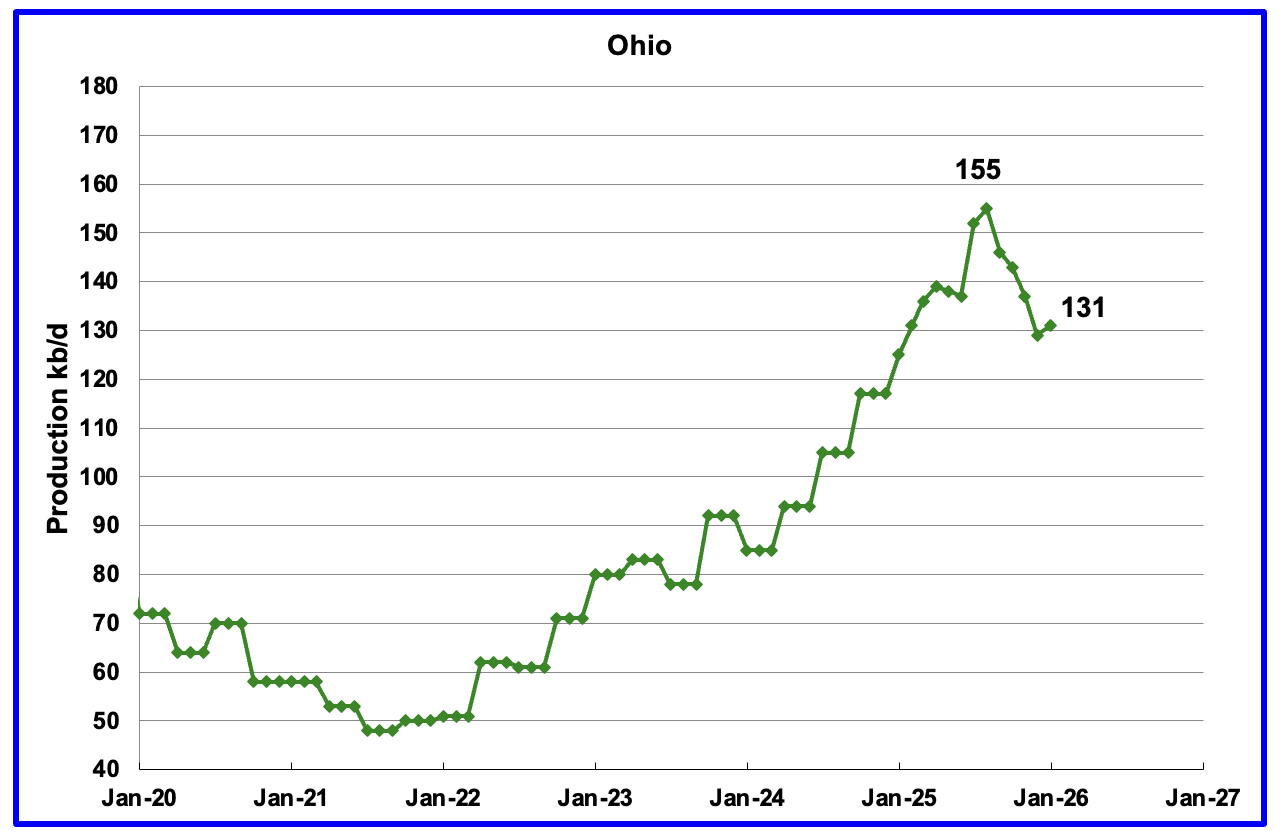
Ohio’s January oil production increased by 2 kb/d to 131 kb/d and was 24 kb/d lower than the August peak of 155 kb/d. In January 2026 Ohio had 12 NG rigs operating. At the end of March, nine NG rigs were operational along with one oil rig.
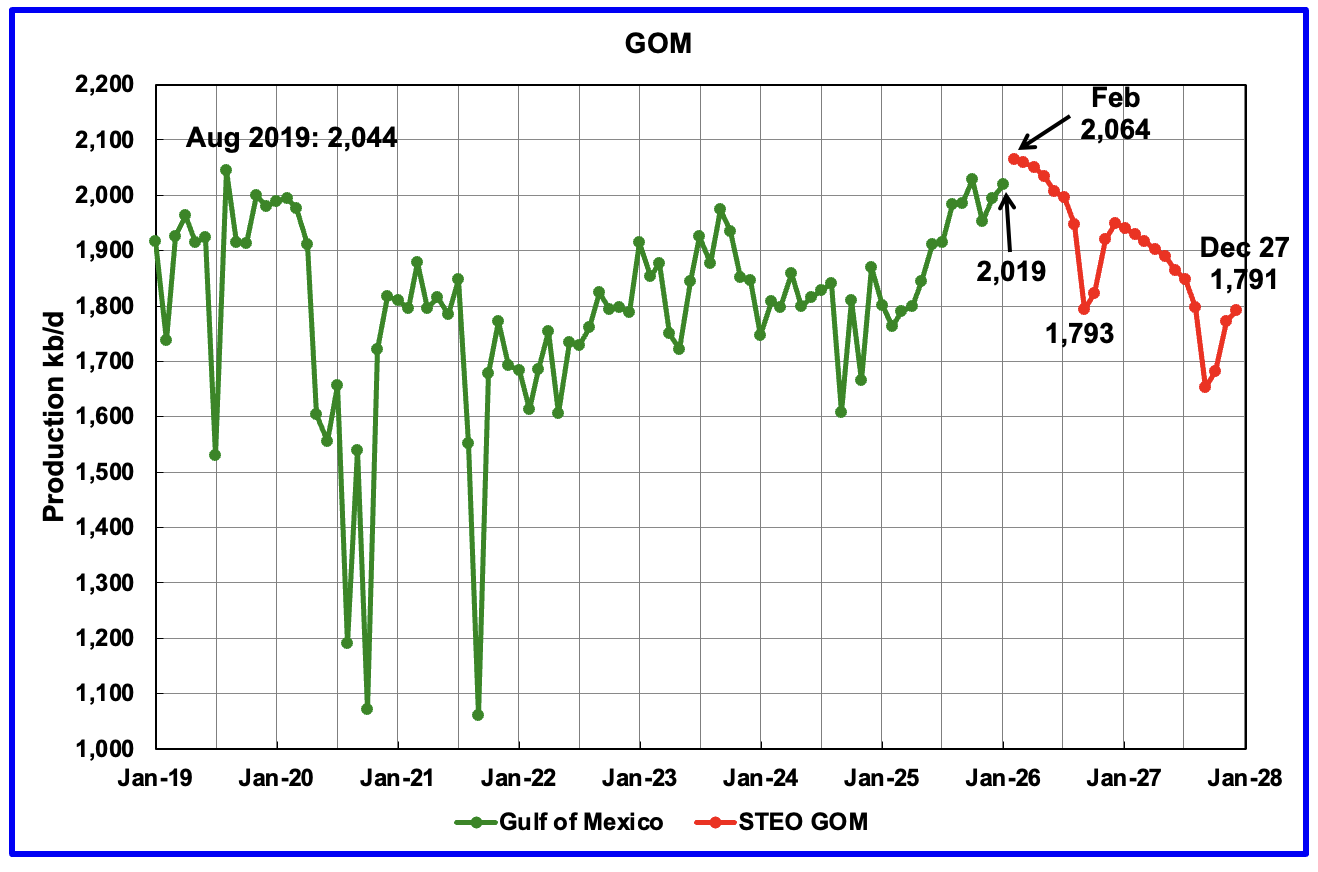
GOM production rose by 25 kb/d in January to 2,019 kb/d.

The March 2026 STEO GOM projection has been added to this chart. For February production is projected to increase to 2,064 kb/d. If the projection is correct, February’s production will be a new high, exceeding the August 2,019 high by 20 kb/d. It also projects production in December 2027 will be 228 kb/d lower than January 2026 at 1,791 kb/d.

While this Article, says three new projects have helped boost US Gulf of Mexico output since mid-2025 and will continue to add to supply, the STEO is indicating that the GOM will peak in February 2026 at 2,064 kb/d.

A Different Perspective on US Oil Production
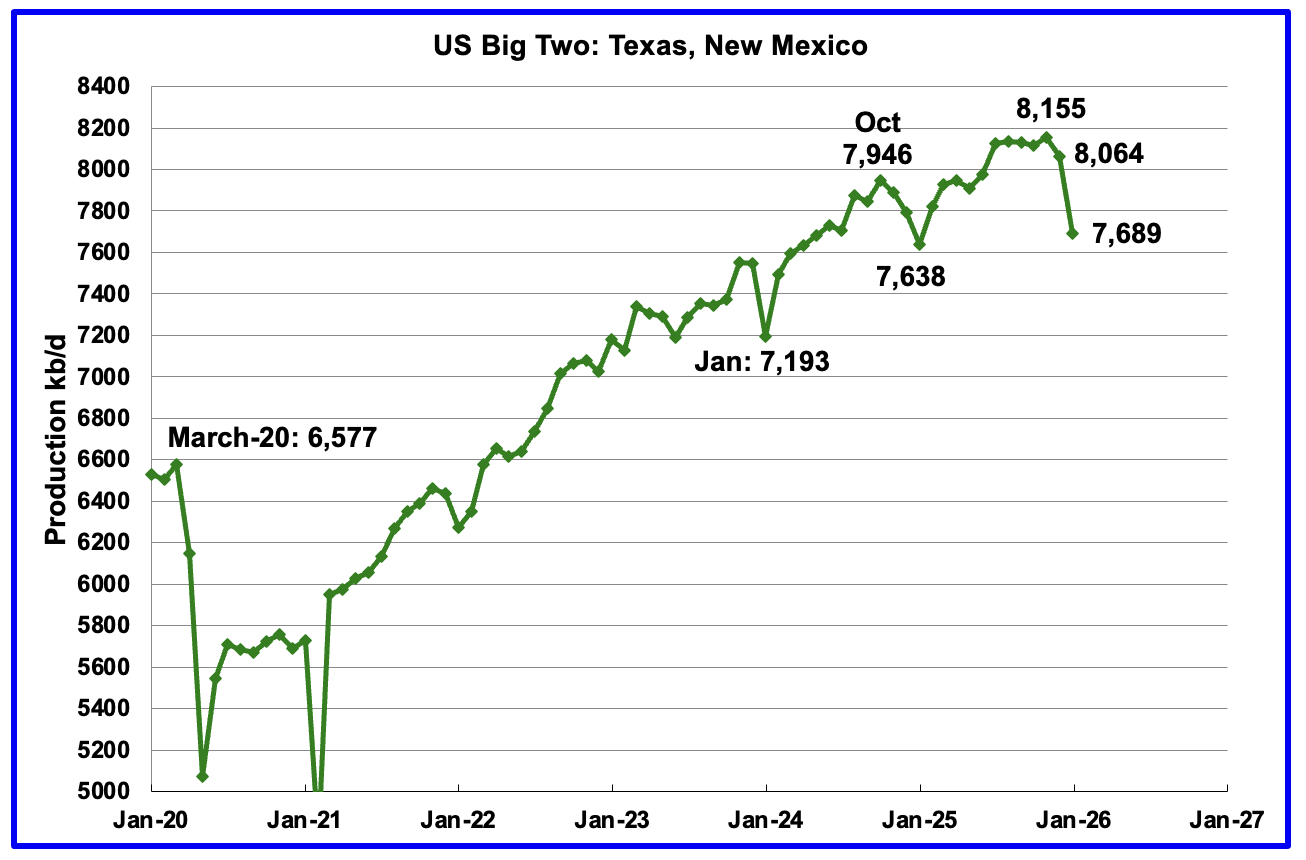
Combined oil output for the Big Two states Texas and New Mexico.

January’s production in the Big Two states decreased by a combined 375 kb/d to 7,689 kb/d. Clearly these two states were the drivers of US oil production growth up to July 2025. The essentially flat production starting in August 2025 was the first sign that production in these two states was close to peaking? The next few months will tell the tale.
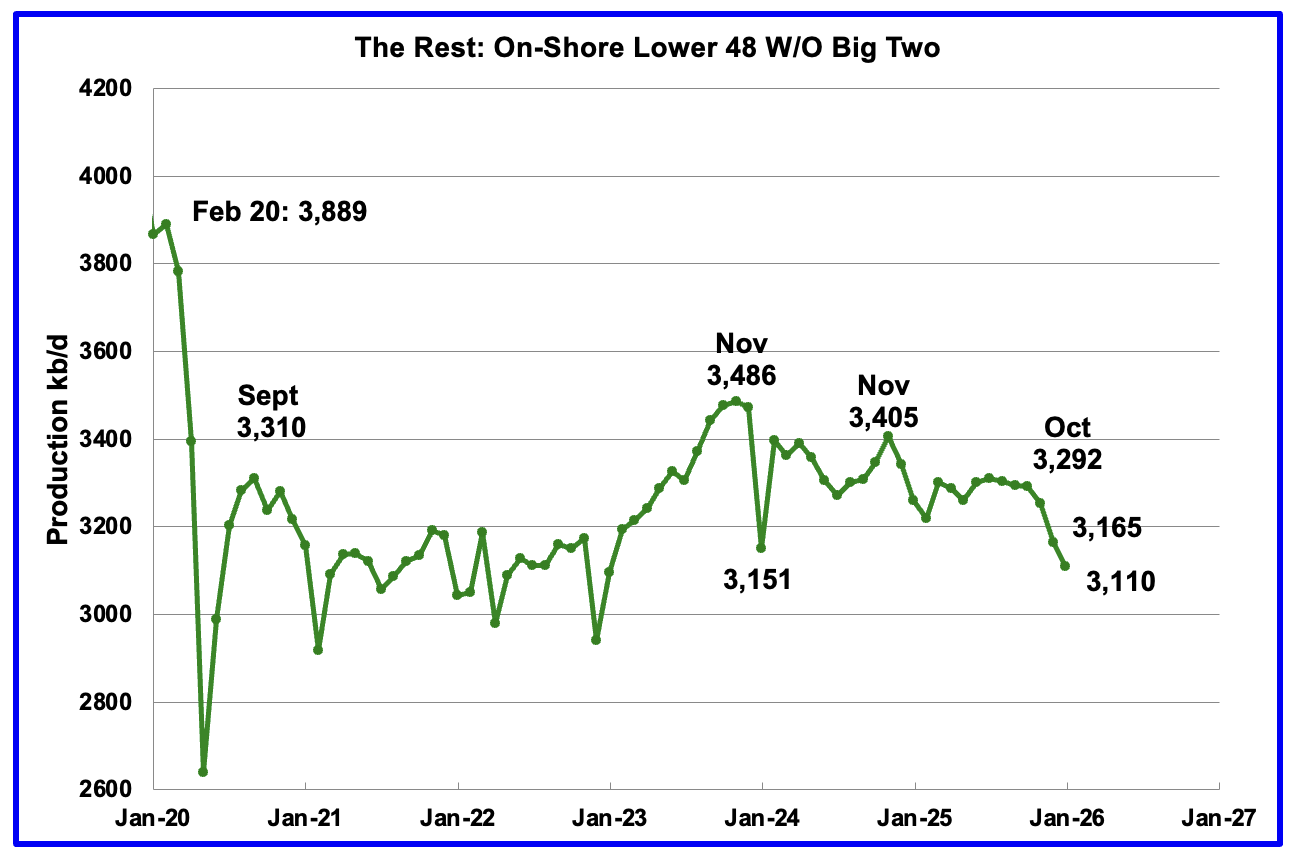
Oil Production by The Rest

January’s oil production by The Rest dropped by 55 kb/d to 3,110 kb/d and is 376 kb/d lower than November 2023.

Permian Basin Report for Main Counties and a District

This special monthly Permian section was added to the US report because of a range of views on whether Permian production will continue to grow or will peak over the next year or two. The issue was brought into focus many months back by two Goehring and Rozencwajg Reports and Report2 which indicated that a few of the biggest Permian oil producing counties were close to peaking or past peak.

A more recent report was issued and can be reviewed Here. In this report they state:

“For years now, we have outlined with what we hoped was clarity, and what we now submit was prescience, the view that U.S. shale oil, that great source of modern supply, could not grow forever. It would mature, crest, and begin its long descent. That moment, by our models and measures, has arrived: shale has plateaued, and 2024 appears to be its high-water mark. And yet, investor sentiment has scarcely been more downbeat.”

This section will focus on the four largest oil producing counties in the Permian, Lea, Eddy, Midland and Martin. It will track the oil and natural gas production and the associated Gas Oil Ratio (GOR) on a monthly basis. The data is taken from the state’s government agencies for Texas and New Mexico. Typically the data for the latest two or three months is not complete and is revised upward as companies submit their updated information. Note the natural gas production shown in the charts that is used to calculate the GOR is the gas coming from both the gas and oil wells.

Of particular interest will be the charts which plot oil production vs GOR for a county to see if a particular characteristic develops that indicates the field is close to entering or in the bubble point phase. While the GOR metric is best suited for characterizing individual wells, counties with closely spaced horizontal wells may display a behaviour similar to individual wells due to pressure cross talking . For further information on the bubble point and GOR, there are a few good thoughts on the intricacies of the GOR in an earlier POB comment and here. Also check this EIA topic on GOR.

New Mexico Permian
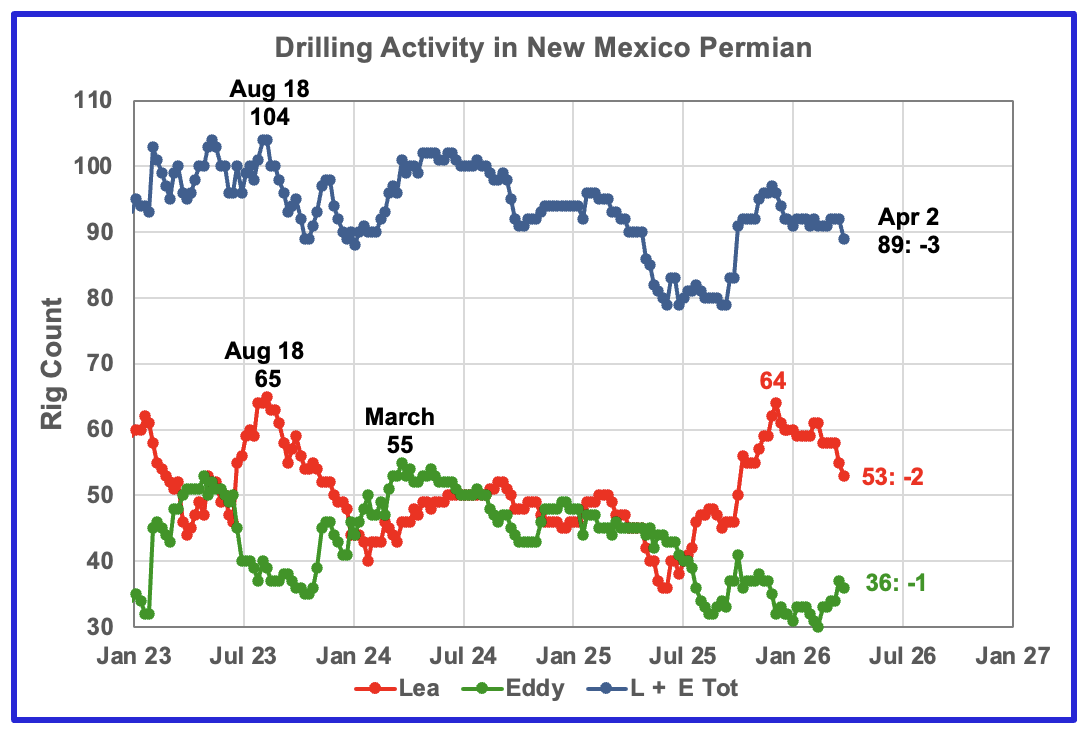
The current rig counts in Lea and Eddy counties are moving in different ways. Lea County has been dropping rigs while Eddy has started adding rigs. Over the past three months Lea County dropped 8 rigs to 53 while Eddy added 6 rigs from 30 in the first week of April. Overall NM dropped 7 rigs to 89 from December to Early April.

Oil Production in New Mexico’s Primary Permian Counties
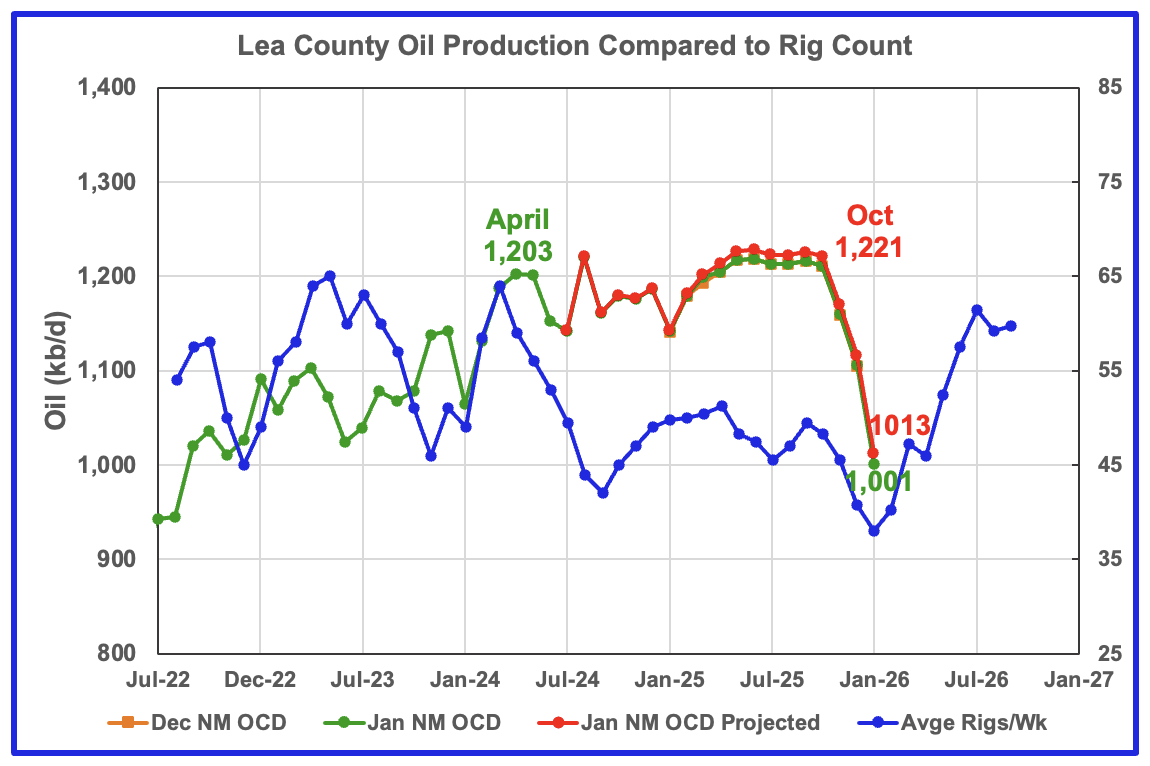
Lea County’s oil production started its plateau phase in April 2024 at 1,203 kb/d and it continued to October 2025. November, December and January have seen production drops in both the projected and NM OCD’s production. However the majority of January’s projected production drop of 104 kb/d is due to the severe January weather. A more realistic drop would have been closer to 60 kb/d to 1,050 kb/d

Preliminary January data from New Mexico’s Oil Conservation Division (OCD) indicates Lea County’s oil production also dropped by 105 kb/d to 1,001 kb/d, green graph, and is a second indictor that production may be in decline in Lea County. The November and December production drop could be associated with the dropping rig count that starts in time shifted October 2025. This raises the question of whether the rising rig count starting in time shifted January 2026 could restore production to a new lower plateau phase.

The blue graph shows the average number of weekly rigs operating during a given month as taken from the weekly rig data. The rig graph has been shifted forward by 7 months. So the 64 Rigs/wk operating in August 2023 have been time shifted forward to March 2024 to show the possible correlation and time delay between rig count, completion and oil production.

Note that rig counts are being used to project production as opposed to completions because state completion data is not available. Completion data from the Drilling Productivity report below indicates that the number of completed DUCs exceeds newly drilled wells in the Permian basin..
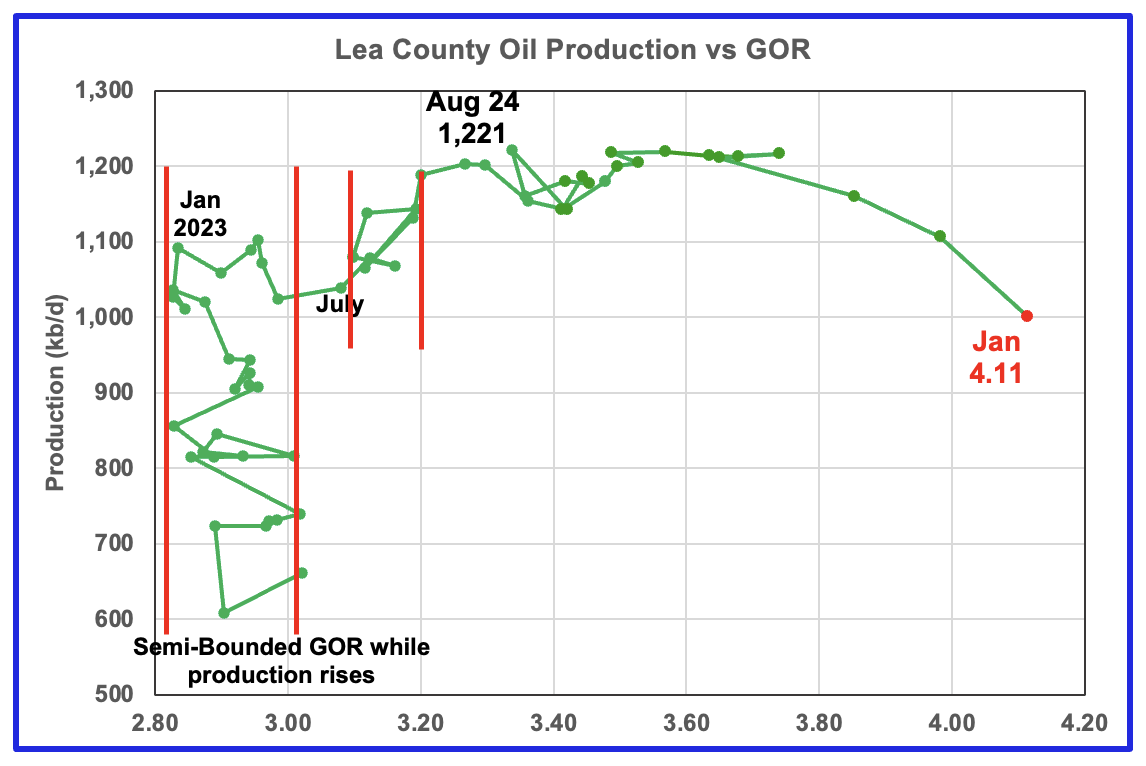
After much zigging and zagging, oil production in Lea county stabilized just below 1,100 kb/d in early 2023. Once production reached a new high in January 2023, production appeared to be on a plateau while the GOR started to increase rapidly to the right and first entered the bubble point phase in July 2023.

Since July 2023 Lea County’s production continued to increase as the GOR remained within a second semi-bounded region. This may indicate that additional production was coming from an oilier part of a layer since the GOR’s behaviour since August 2023 to March 2024 time frame appears once again to be in a second semi bounded GOR phase accompanied with rising production.

The GOR moved out of the second semi-bounded GOR region in April 2024 and production hit a new high of 1,221 kb/d in August 2024. From August 2024 to February 2025 the GOR was range bound between 3.34 and 3.53 but starting in October 2025 to January 2025 the GOR has risen every month to hit new highs. January saw both a production drop to 1,001 kb/d and the GOR increase to a record 4.11. This is another indicator that Lea County may have entered its declining phase.

This zigging and zagging GOR pattern within a semi-bounded GOR while oil production increases to some stable level and then moves out to a higher GOR to the right has shown up in a number of counties. See a few additional cases below. The rising GOR to new highs and dropping oil production in Lea county is an early indicator that production may be entering a declining phase.
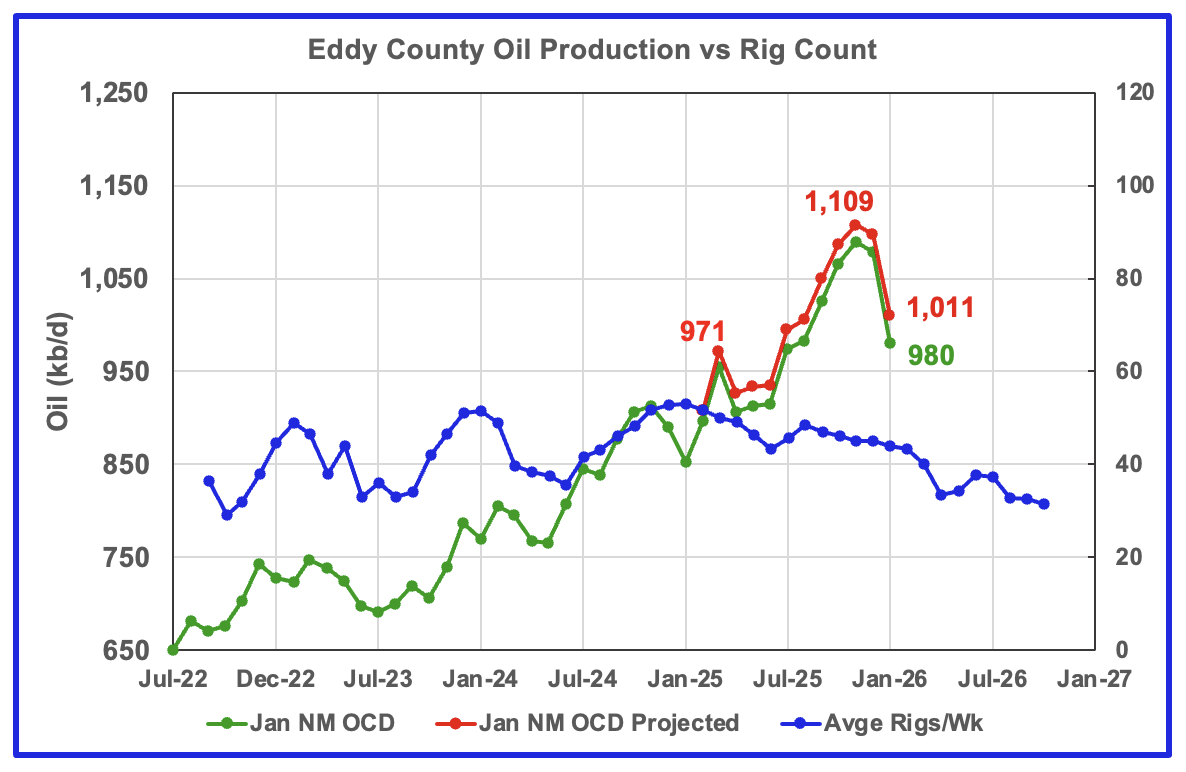
January’s projected oil production decreased by 87 kb/d to 1,011 kb/d while preliminary production from the NM OCD decreased by 98 kb/d to 980 kb/d. Again most of the production drop was due to severe January weather. Eddy’s month over month production updates are typically very few and small and primarily occur in the last two or three months which indicates that the monthly updates are close to being final, say 95% of final. A more realistic projection for January would be closer to 1,060 kb/d. February’s production data should rebound as the winter weather effects are offset.

Note that from June 2025 to November 2025 projected production in Eddy County increased by 172 kb/d. The December and January production drops may be indicating an upcoming peak.

Note that the peak production reported last month has been reduced by 80 kb/d to 1,109 kb/d due to updated November production.

The rising production for July and August could be linked to the increasing rig count starting in time shifted June 2025. However the rig count for September and October and going forward is dropping while production continues to rise. This implies that Eddy County has been drilling in some very productive areas or been completing extra DUCs or drilling longer laterals beyond three miles.

The blue graph shows the average number of weekly rigs operating during a given month as taken from the above weekly drilling chart. The rig graph has been shifted forward by 8 months to roughly coincide with the increase in the production graph starting in October/November 2023.
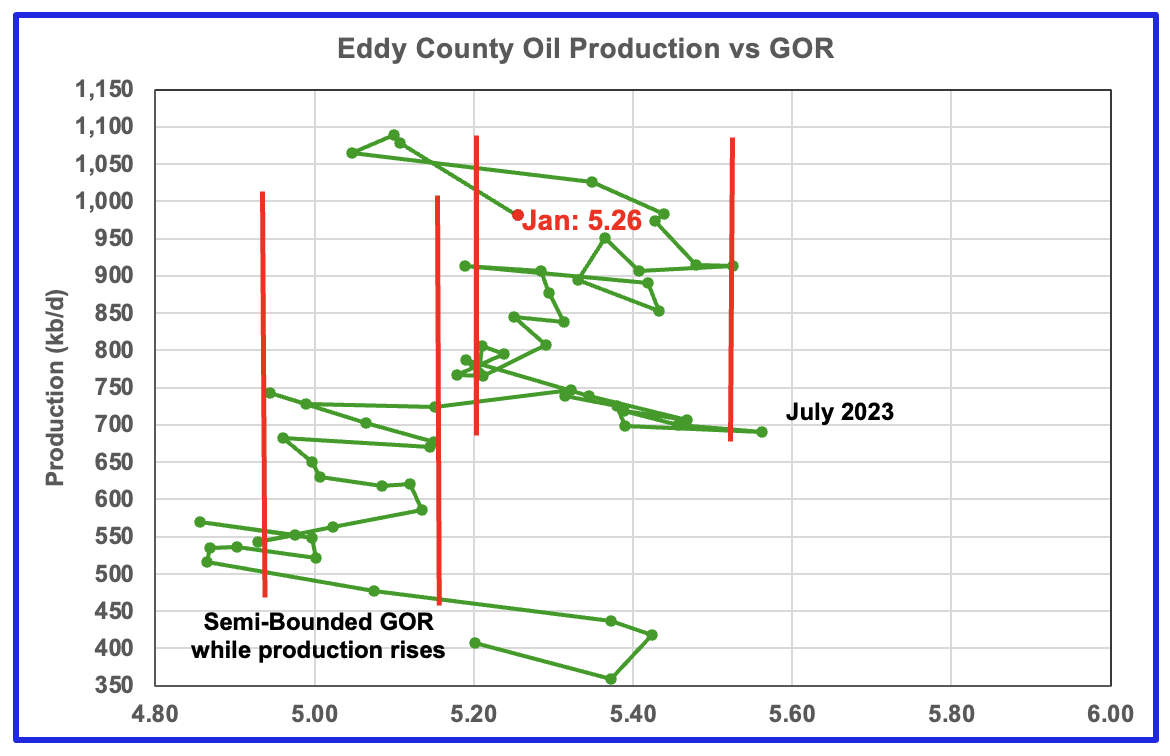
The Eddy county GOR pattern is similar to Lea county except that Eddy broke out from the first semi bounded range earlier and then added a second wider semi-bounded GOR phase. For January New Mexico’s Oil Conservation Division (OCD) reported preliminary oil production decreased by 98 kb/d to 980 kb/d while the GOR rose to 5.26 from 5.11 and moved back into the second Semi-Bounded GOR range.

Texas Permian
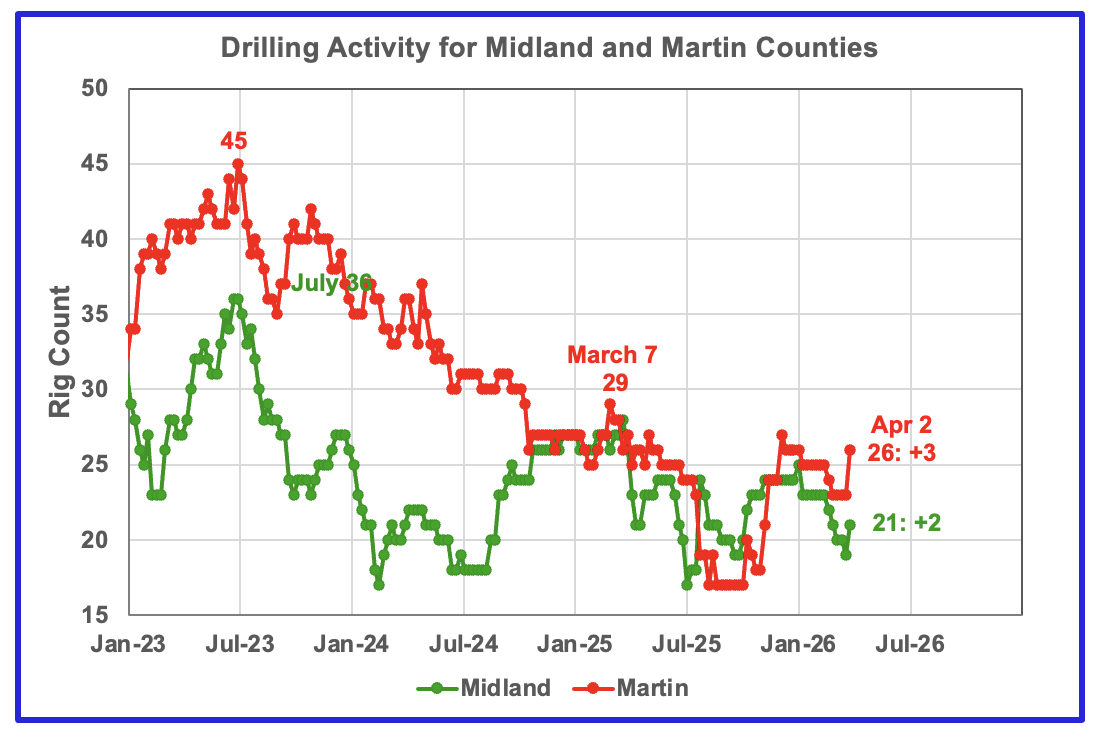
The rig counts in both Midland and Martin counties decreased over the past few months. However in the first week of April, rigs were added, possibly due to higher oil prices of $111.52/b. Martin dropped rigs from December to March but then added rigs in early April. Midland dropped 6 rigs from early January to 19 in late March and then added 2 to 21 in early April.

Oil Production in Primary Permian Texas’ Counties
Comparison Chart
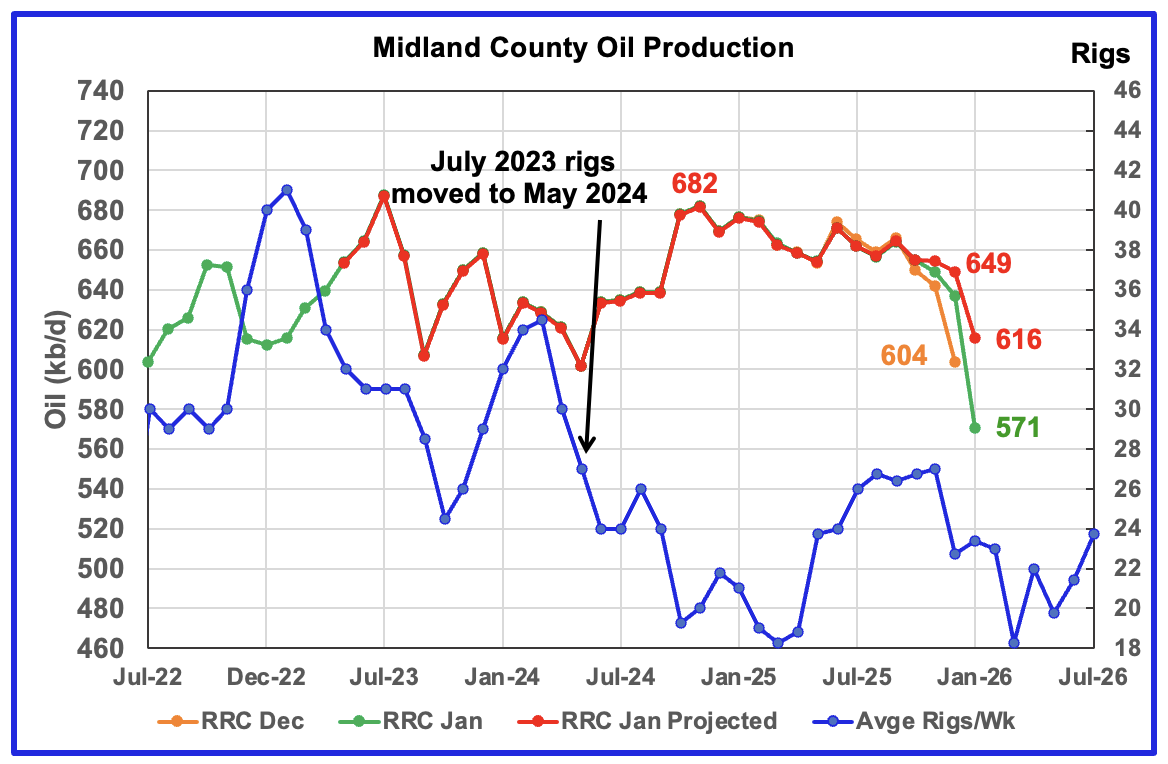
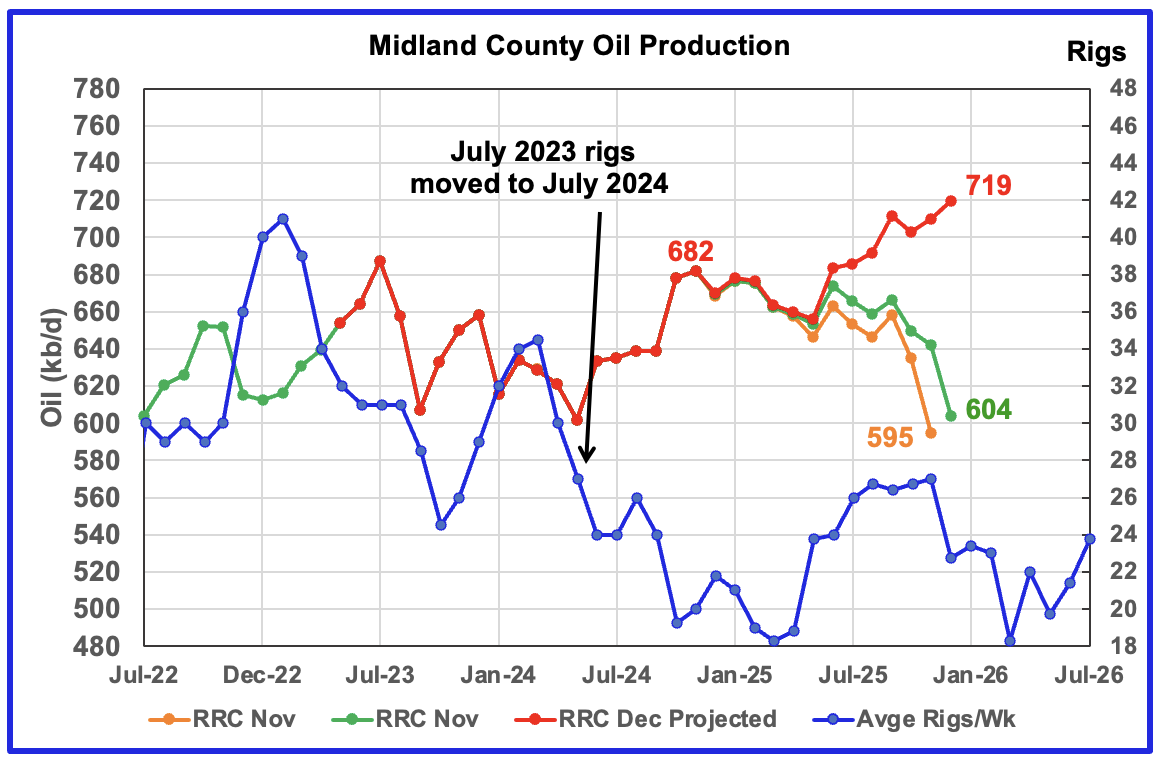
January’s projected production dropped by 33 kb/d to 616 b/d. Part of this drop is due to the severe Texas winter storm in late January. Midland county along with many others experienced this January production drop.

The two previous Midland reports showed projected production starting to rise in June 2025 and roughly followed the time shifted rising rig count, see comparison chart above. However for January’s update projected production began dropping in June 2025. This is quite a change and is due to better updated Texas data. Note the smaller extent of month over month production increments, compare the gap between the orange and green graphs.

This current chart shows production peaking in November 2024 at 682 kb/d. Also the projection and Texas data are very close up to September 2025. Combining the dropping production with the sharp drop in the time shifted November 2025 rig count makes me think that Midland’s oil production has entered its declining phase.

The orange and green graphs show preliminary oil production for Midland County as reported by the Texas RRC for December and January. The red graph uses December and January data to project production as it would look after being updated over many months.

The blue graph shows the average number of weekly rigs operating during a given month as taken from the weekly drilling chart. The rig graph has been shifted forward by 8 months, revised down from 10, to better align with the latest production.
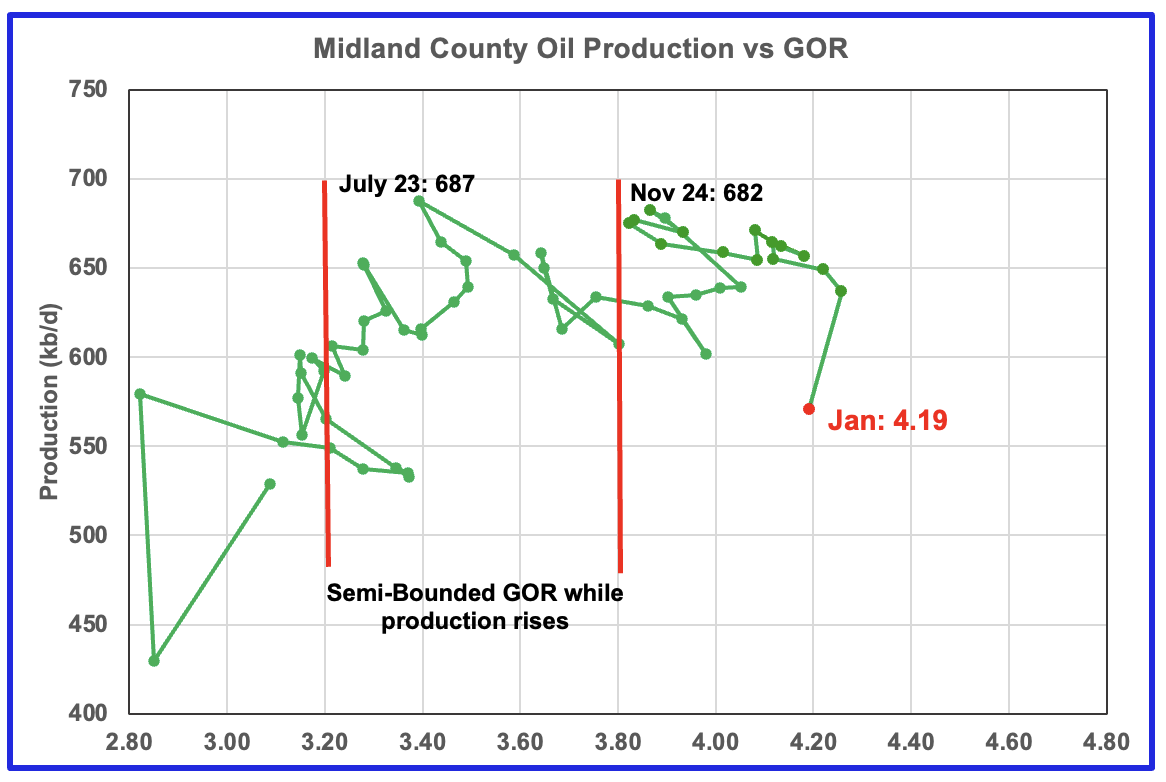
For January the Midland GOR ratio dropped to 4.19 from 4.26 in December while the reported preliminary oil production dropped by 66 kb/d to 571 kb/d.

When Midland county GOR initially moved into the bubble point phase, oil production and the GOR stayed within a narrow GOR range of 3.8 to 4.2 outside of the initial Semi-Bounded GOR region from March 2024 to October 2025. For January it has dropped back into the narrow range.

The January drop in oil production and casinghead gas was 10% and 12%, respectively. The drop in Gas Well gas was 23%. Since the GOR includes gas from gas wells, this implies more gas wells were affected/closed than oil wells and could explain why the GOR has dropped.

The overall rising GOR is another indicator that Midland County may have passed peak production.

The oil production and GOR data shown in this chart are based on the RRC’s January preliminary production report.
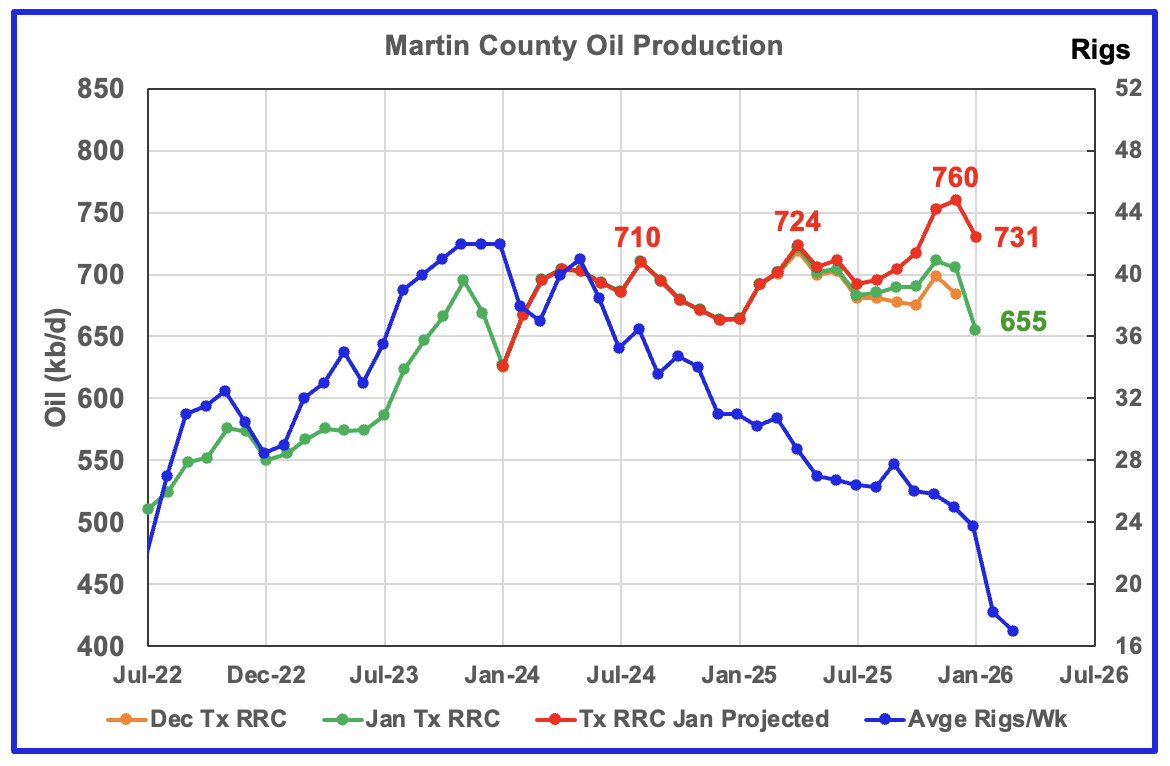
Martin county’s projected January oil production dropped by 29 kb/d to 731 kb/d. Part of this drop is due to the severe Texas winter storm in late January.

I think the December projected production of 760 kb/d is a bit optimistic due to the large revisions to the monthly increments between the Texas RRC’s January and December reports.

Considering the August 2024 and April 2025 peaks are both close to 717 kb/d and considering the falling rig count, a more realistic production estimate for December would be closer to 730 kb/d. Will the falling rig count since time shifted July 2025 begin to take its toll in 2026?

The red graph is a projection for oil production as it would look after being updated over many months. This projection is based on a methodology that uses preliminary December and January production data.

The orange and green graphs show production for Martin County as reported by the Texas RRC for December and Januart. The blue rig graph time shifts the rig count forward by 6 months.
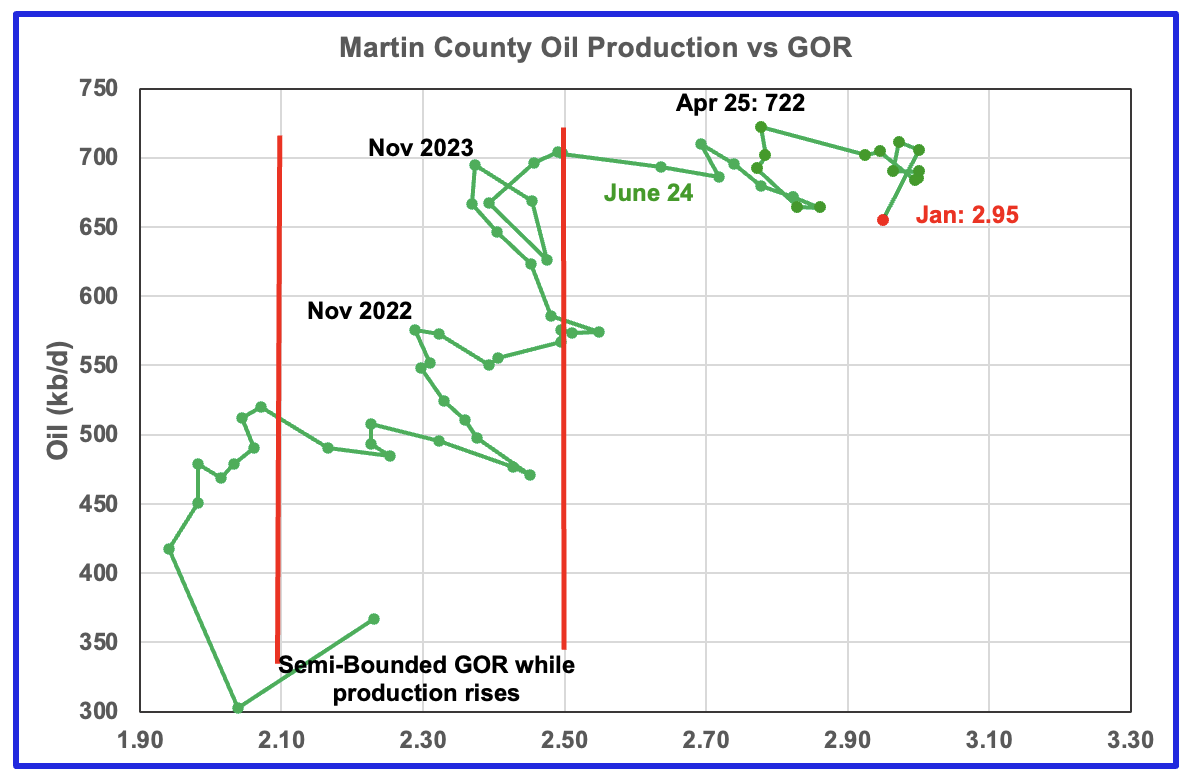
Martin county’s oil production after November 2022 increased and at the same time drifted to slightly higher GORs within the semi bounded range. However the June 2024 GOR saw its first move out of the semi bounded region. The RRC’s preliminary January 2026 production for Martin County shows a 51 kb/d decrease to 655 kb/d accompanied by a decrease in the GOR to 2.95.

Martin county has the lowest semi-bounded GOR boundary of the four counties at a GOR of close to 2.50. The January GOR is now clearly out of the semi-bounded region. Martin County has now entered the bubble point phase that should result in a plateau phase that should shortly turn into a slowly dropping oil production phase.
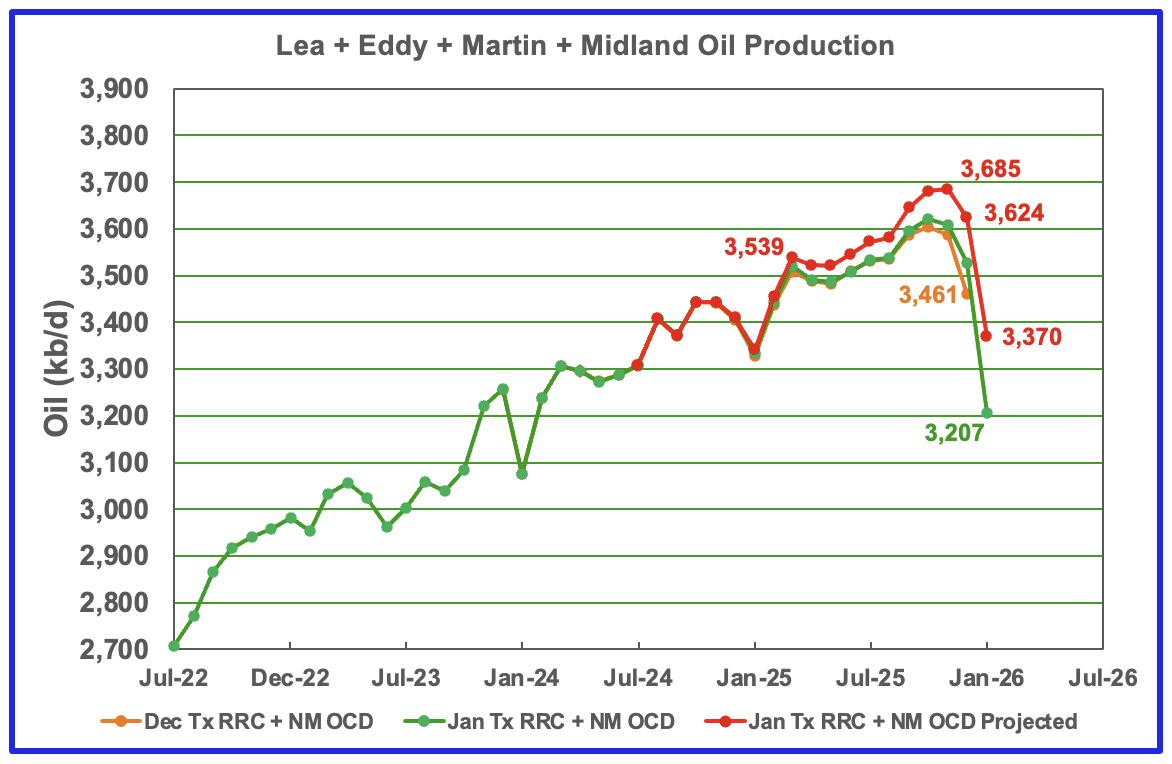
This chart shows the total oil production from the four largest Permian counties. Assuming current Permian production is close to 6,600 kb/d, these four counties account for 51% of the total.

January’s projected production decreased by 254 kb/d to 3,370 kb/d and is the second monthly production drop and is largely due to the late January winter storm. Of the 254 kb/d drop, the largest drops came from Lea and Eddy counties, 104 kb/d and 87 kb/d respectively.

Last month I wrote: “Due to the unusually late revisions from the NM OCD, I think December projected production is too high by close to 100 kb/d. In other words December projected production should be closer to 3,650 kb/d.” This month it has been revised down to 3,624 kb/d.

The December and January initial production data are shown in the orange and green graphs respectively. The red graph uses the December and January production data to project a final updated production for January.

Findings

This month’s production drops are due to a combination of a severe winter storm and natural decline which should result in increased production in February in one or two of these four counties.

– The preliminary January production data for both New Mexico and Texas was OK and provided reasonable projections for January.

– Lea county entered its plateau phase in May 2024. While oil production is not following the rig count graph directly, the dropping rig count has resulted in Lea County production being in a steady flat plateau phase up to September 2025. However October to January had production drops which indicate Lea County has entered a declining phase. That declining phase could enter a lower level plateau phase in 2026 as the time shifted February rig count begins to increase.

– July to November production in Eddy County saw a steady increase to 1,110 kb/d. While November’s projected production increased, it was smaller than previous monthly increases and may be indicating the beginning of a peaking/declining phase. The drop in December and January production is another indicator that Eddy’s production may have peaked. The full effect of January’s severe weather on January production will not be known until February’s production is reported.

– Updated January Texas RRC production data shows that Midland County’s projected production dropped from January 2025 to December 2025. This makes me think that Midland’s oil production has entered its declining phase. However the rising time shifted rig count starting in March 2026 may indicate an upcoming rising production phase but not to a new high. The addition of six new rigs to Midland county in real August 2025 to 24 from 18 was an unexpected surprise and makes one wonder what it implies for Midland county oil production going forward after allowing for the rig count to production delay.

– Martin’s county January projected production drop indicates that its oil production may be in a plateau phase of close to 725 kb/d.

Texas District 8
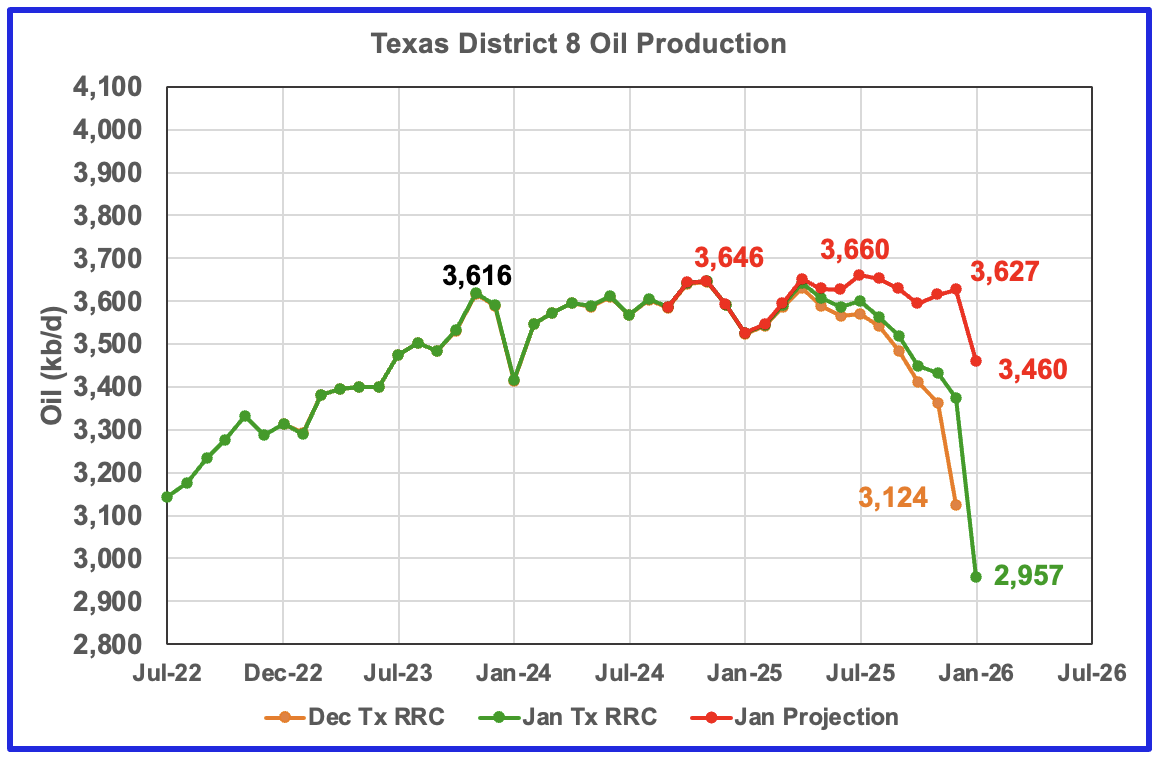
District’s 8 projected production dropped by 167 Kb/d in January. District 8 has shown 3 peaks from October 2024 to December 2025. This is a strong indicator that District 8 is now in its plateau phase before entering its dropping phase. 
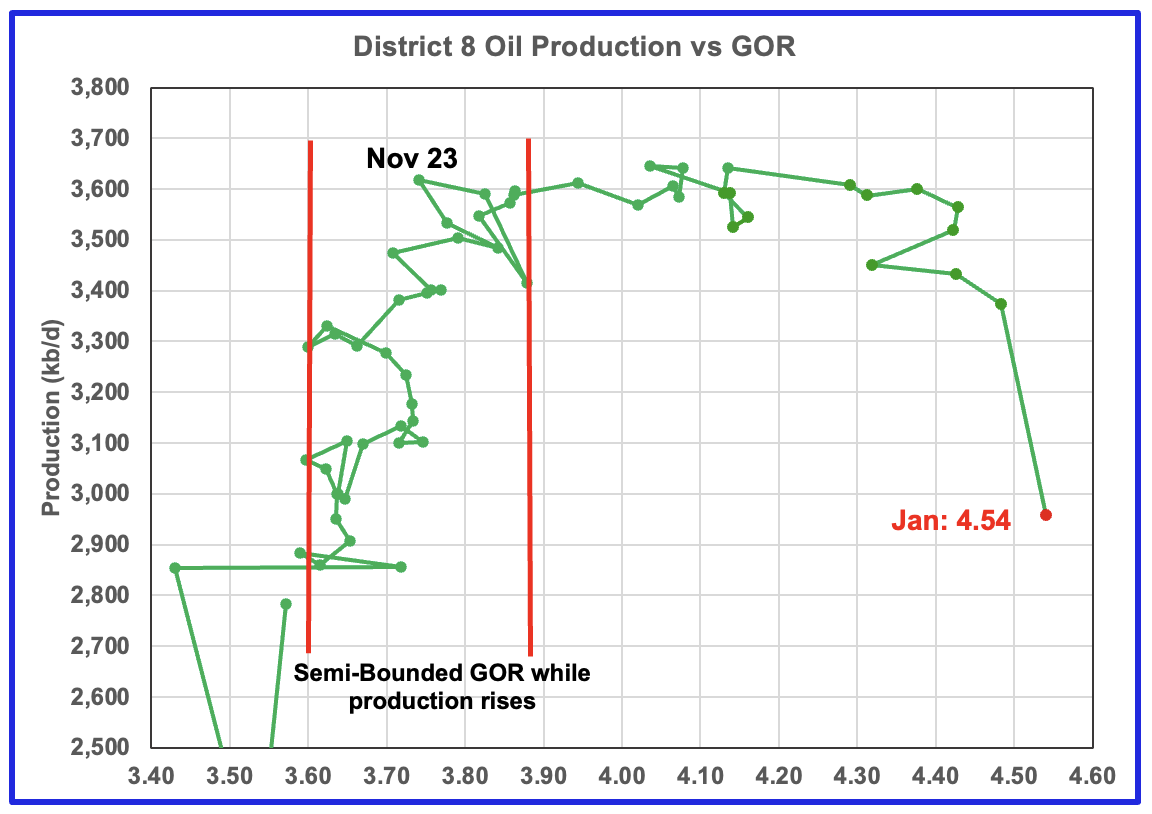
Plotting an oil production vs GOR graph for a district may be a bit of a stretch. Regardless here it is and it seems to indicate many District 8 counties may well be into the bubble point phase. The December GOR increased to 4.54, a new high, as the preliminary RRC production took a large drop of 416 kb/d to 2,957 kb/d.

Oil Production and GOR Charts for Four of the Next Larger Texas Oil Counties

Texas January data appears to be reasonable as are the county projections.
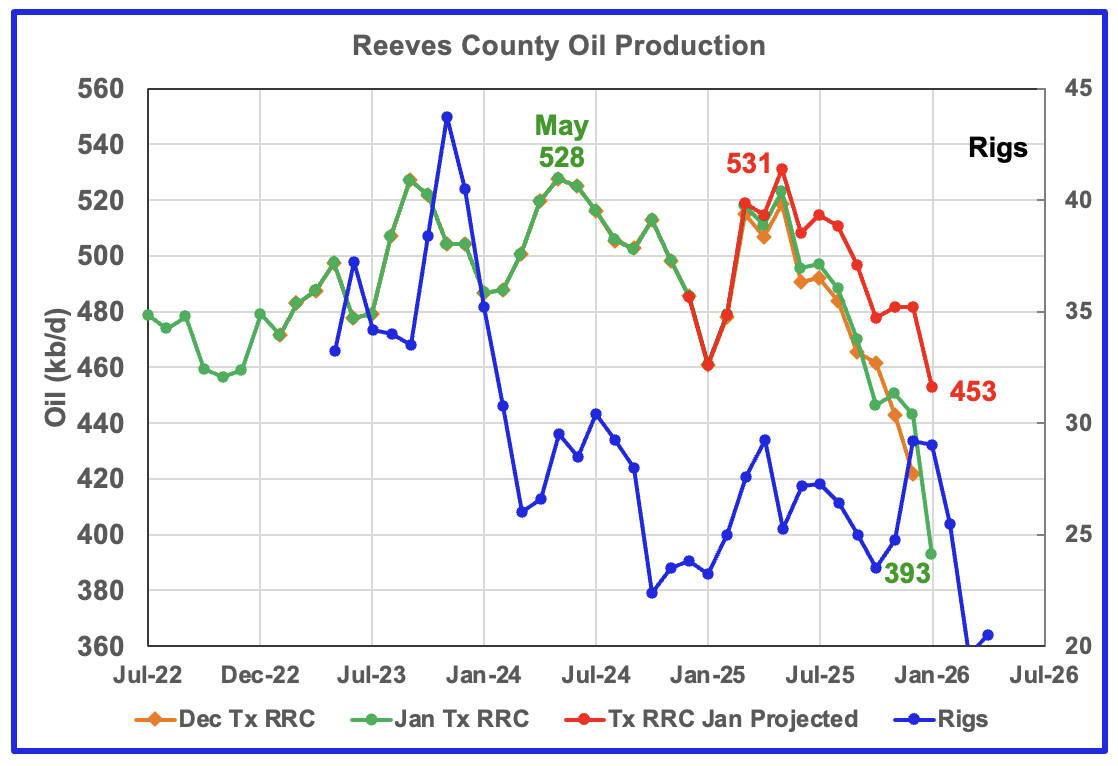
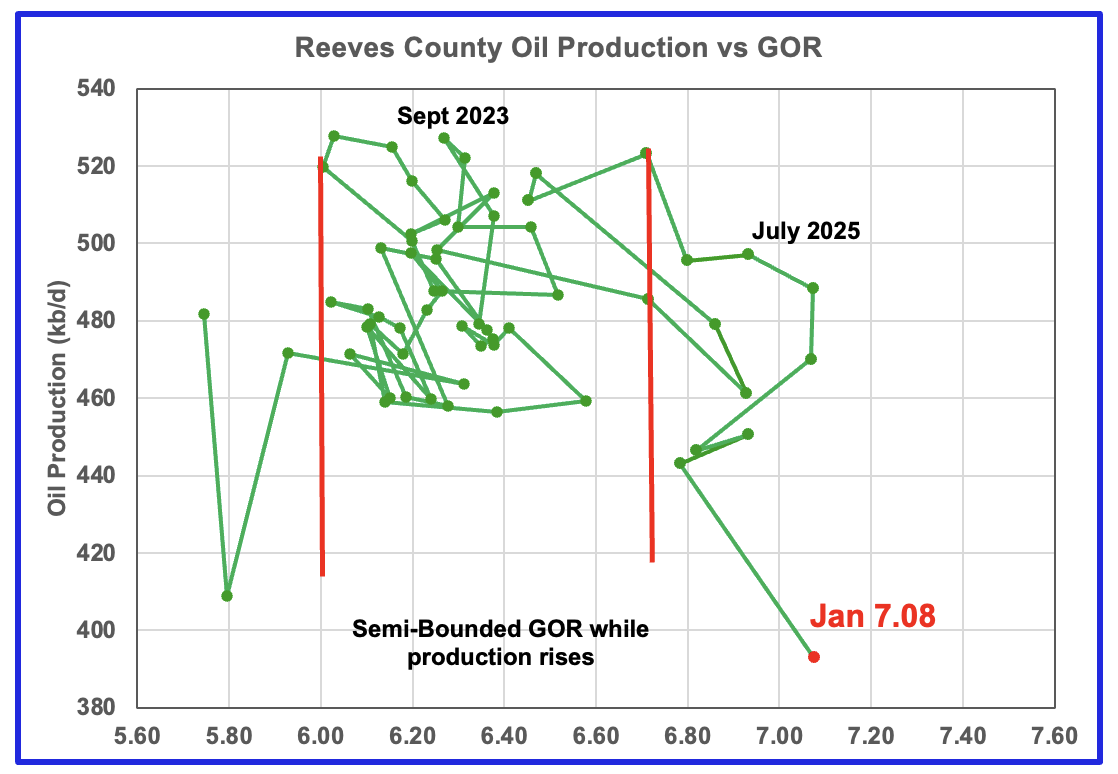
Reeves County GOR is high because it is the number one Texas county ranked by gas production. The current C + C production is almost split between crude and condensate, with condensate about 5% higher than crude.

Reeves County GOR first moved out of the Semi-Bounded region in June 2025 and in January reached a new high of 7.08 while initial production dropped to a new low of 393 kb/d.

The rig count is time shifted forward by 7 months.

In real June 2025, 29 rigs were operational in Reeves county. By late March 2026 the rig count had dropped to 11. That is a large drop in 9 months.
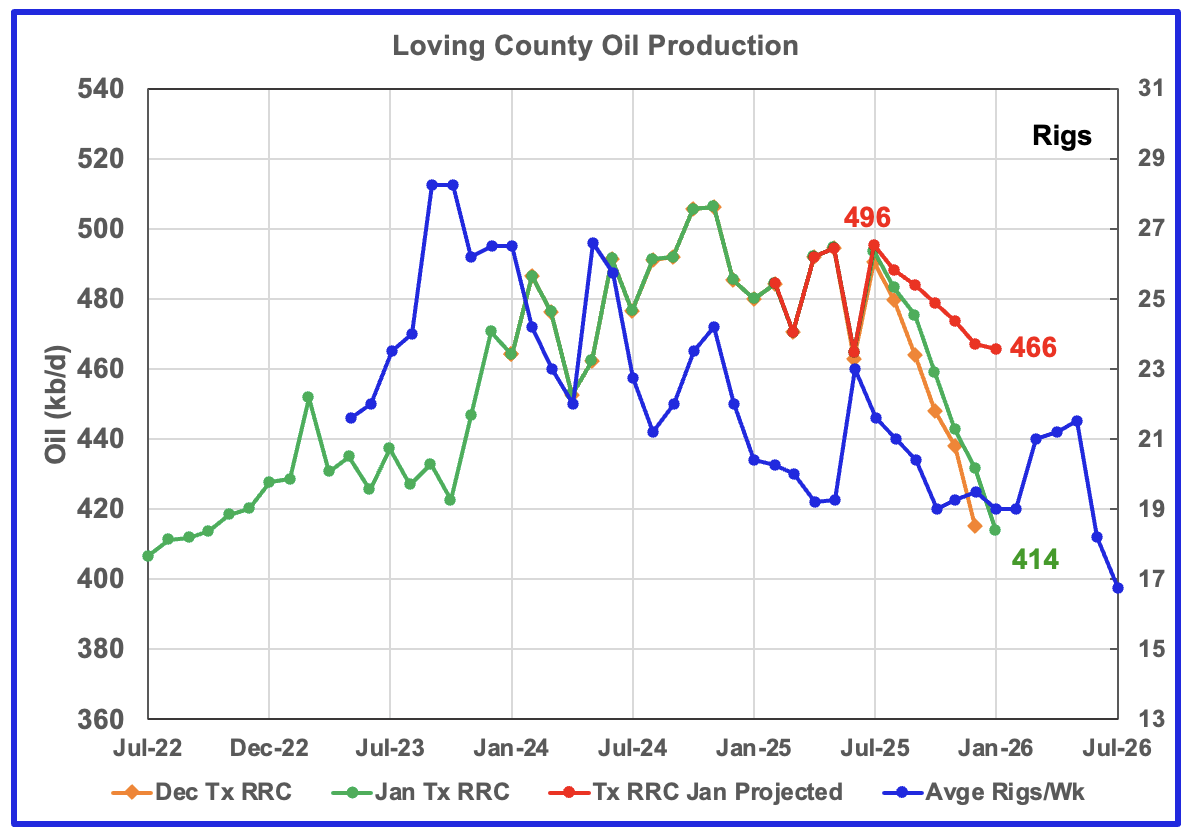
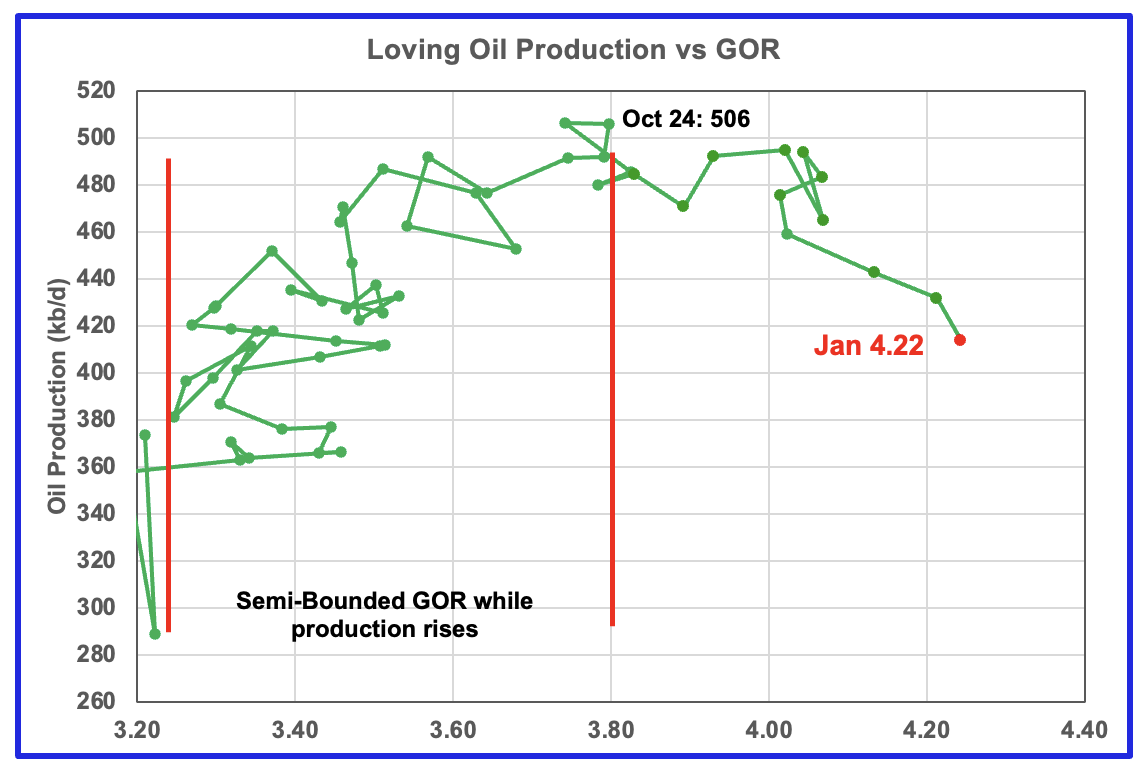
Loving’s projected production dropped by 1 kb/d to 466 kb/d in January. For January, the GOR increased to 4.22, a new high, while preliminary production has continued to drop since August 2025.

Loving’s rig graph is time shifted forward by 8 months.

While Loving had 19 operational rigs in real June 2025, they jumped by 3 to 22 in real September and then dropped to 18 in early April.
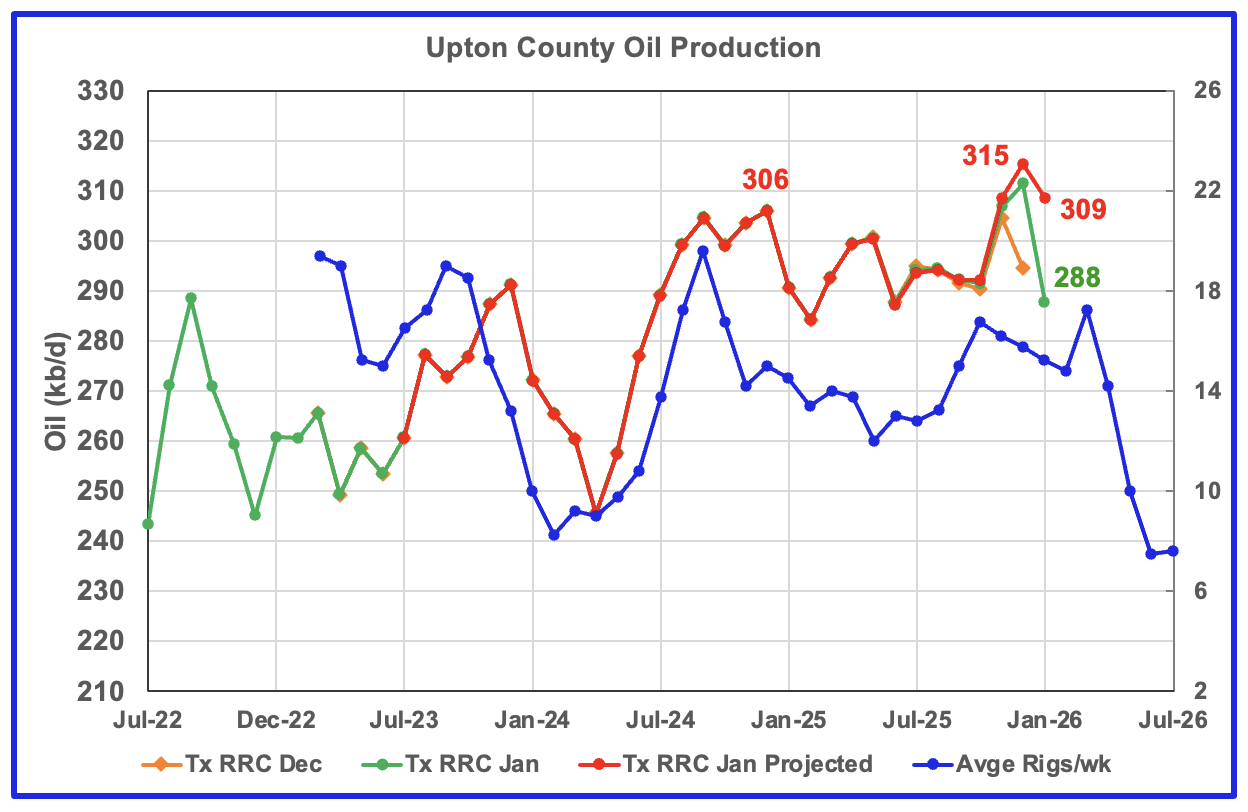
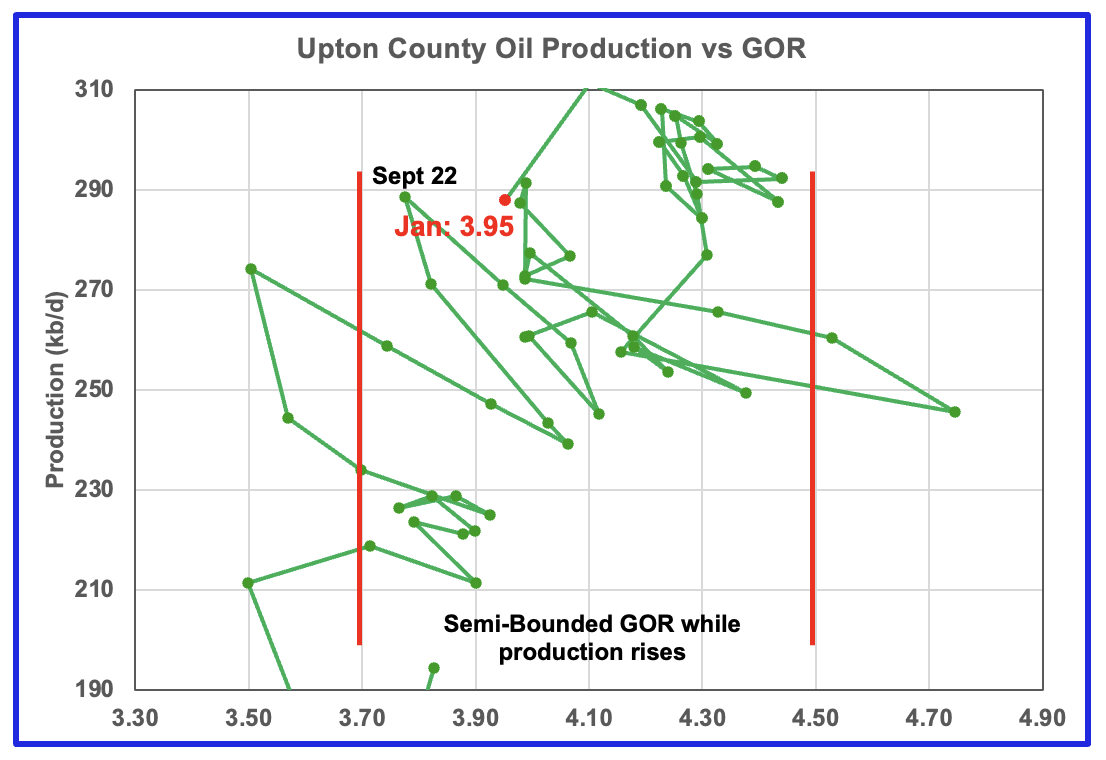
Upton’s projected January production dropped by 6 kb/d to 309 kb/d.

For the next few months Upton County may see a production increase associated with the rising rig count which started in time shifted August 2025. A decline may begin in time shifted April 2026 as the rig count begins to drop..

Upton’s GOR continues to stay within the Semi-Bounded region at 3.95.

Upton’s rig chart has been time shifted forward by six months. Upton began 2026 with 7.6 rigs. In real March 2026, 11 rigs were operating.
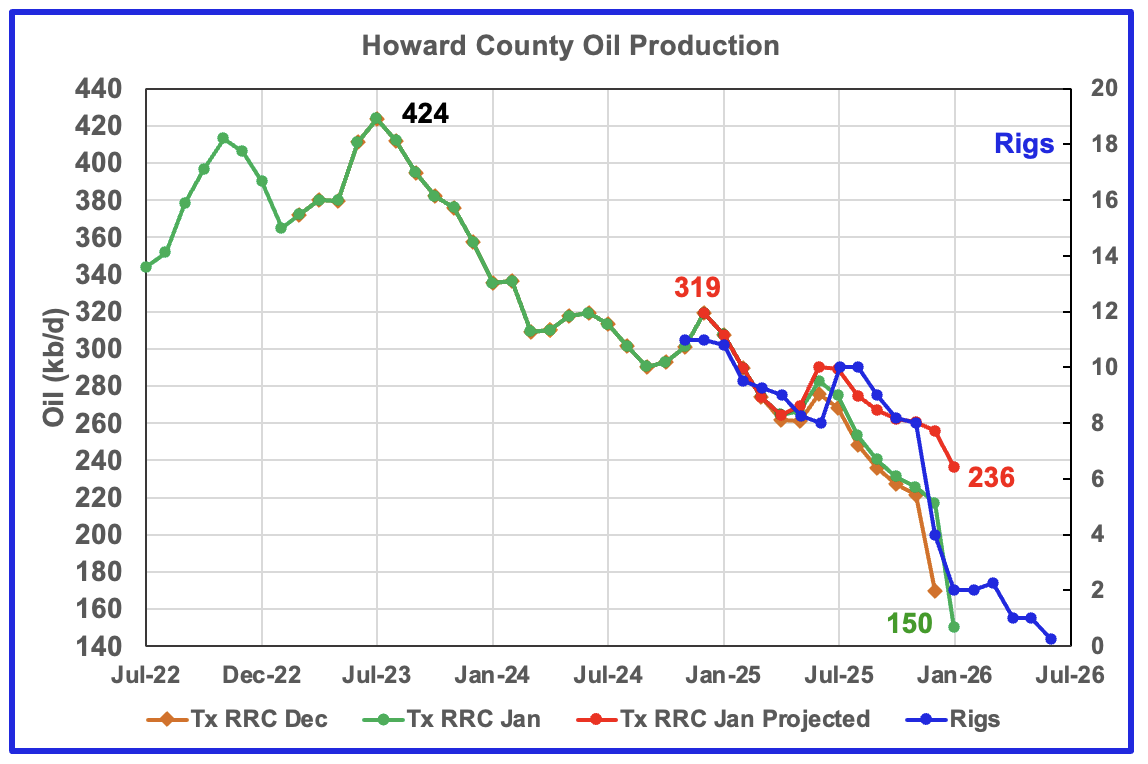
Howard County oil production peaked in July 2023 and has been in a slow decline ever since.

In January the projected production dropped by 20 kb/d to 236 kb/d.

Note the rig count in time shifted June 2026 is 0.25, i.e. 1 rig for one week in real January 2026. The rig graph is time shifted forward by 5 months.

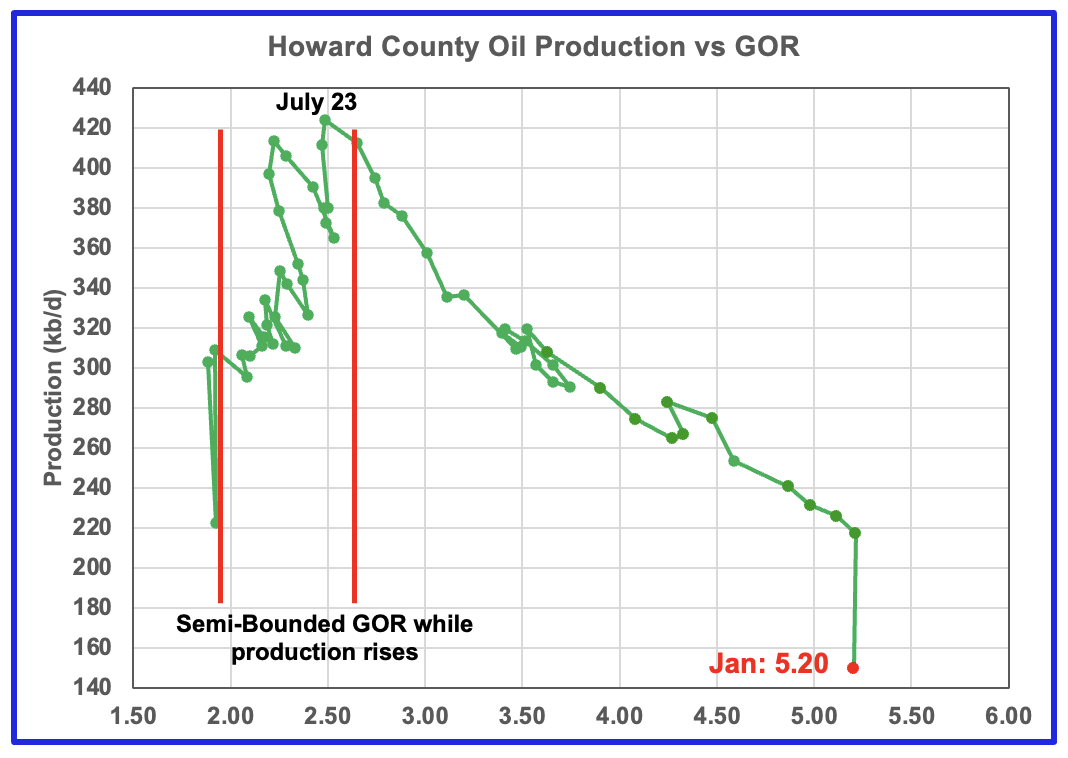
For January the GOR dropped slightly to 5.20 as the initial production dropped steeply to 150 kb/d.

Drilling Productivity Report

The Drilling Productivity Report (DPR) uses recent data on the total number of drilling rigs in operation along with estimates of drilling productivity and estimated changes in production from existing oil wells to provide estimated changes in oil production for the principal tight oil regions. The new DPR report in the STEO provides production up to February 2026. The report also projects output to December 2027 for a number of basins. The DUC charts and Drilled Wells charts are also updated to February 2026.
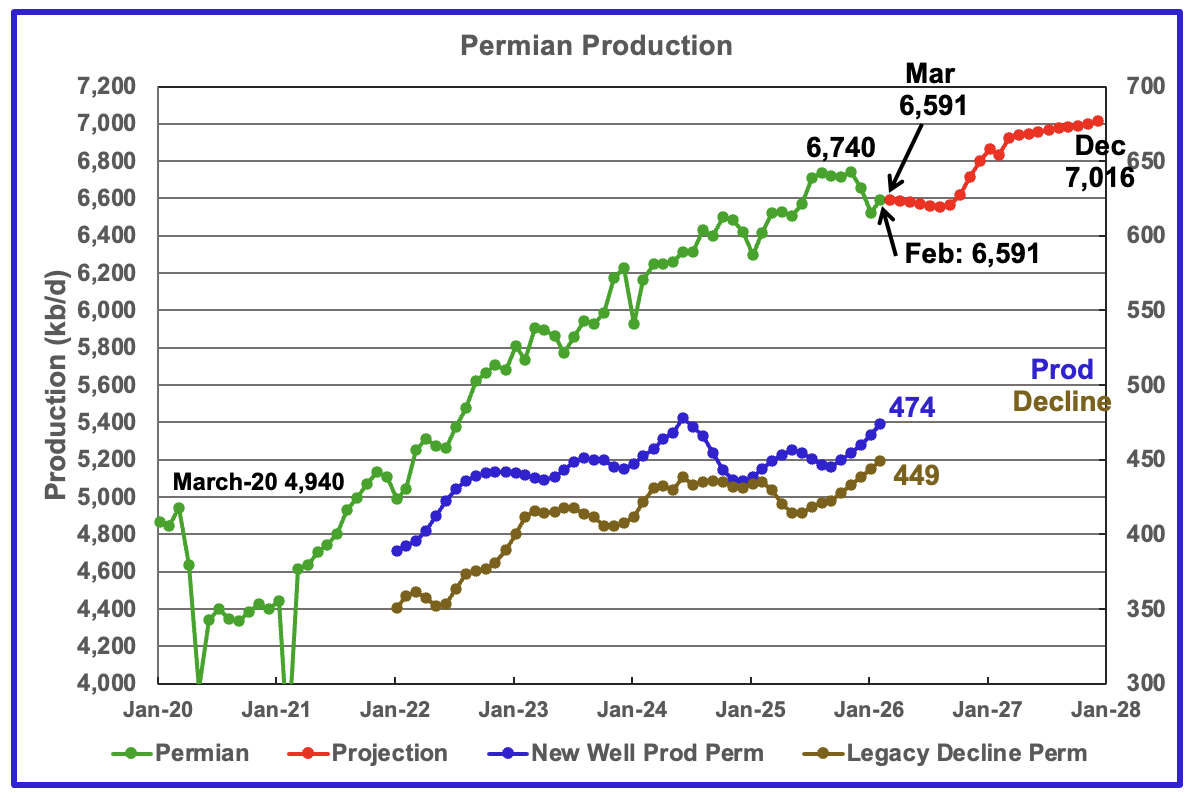
The EIA’s March STEO/DPR report shows Permian February output rose by 70 kb/d to 6,591 kb/d. The rise is due the rebound from severe winter weather in late January. March production is expected to be the same as February. From March 2026 to December 2027 output is expected to increase by 425 kb/d to 7,016 kb/d. December 2027 production has been revised up by 455 kb/d.

There are two significant changes/revisions to the March chart.

Production drops from March 2026 to August 2026. This drop I think is related to either a low number or no oil wells being brought online during the winter storm in late January. With no wells being brought on line, the steep drop in the new wells brought online in the previous two months rears its ugly head. The lack of daily new wells being brought on line during the storm are required to partially offset that steep decline. Note production never recovers to the December level. It is pretty well a slow downhill story after March 2026.

Production begins to rise steadily from October 2026 to December 2027. According to the EIA, this is due to higher prices for WTI and more NG pipelines being built. The gas pipelines are needed too capture the associated flared gas coming from new oil wells.

Production from new wells and legacy decline, right scale, have been added to this chart to show the difference between new production and legacy decline.

These numbers reflect a one year production trend and provide the production contribution from new wells over a rolling 12-month period to determine if the rate of new production is increasing or decreasing compared to previous periods. The averaging process approximately adds a six month delay.
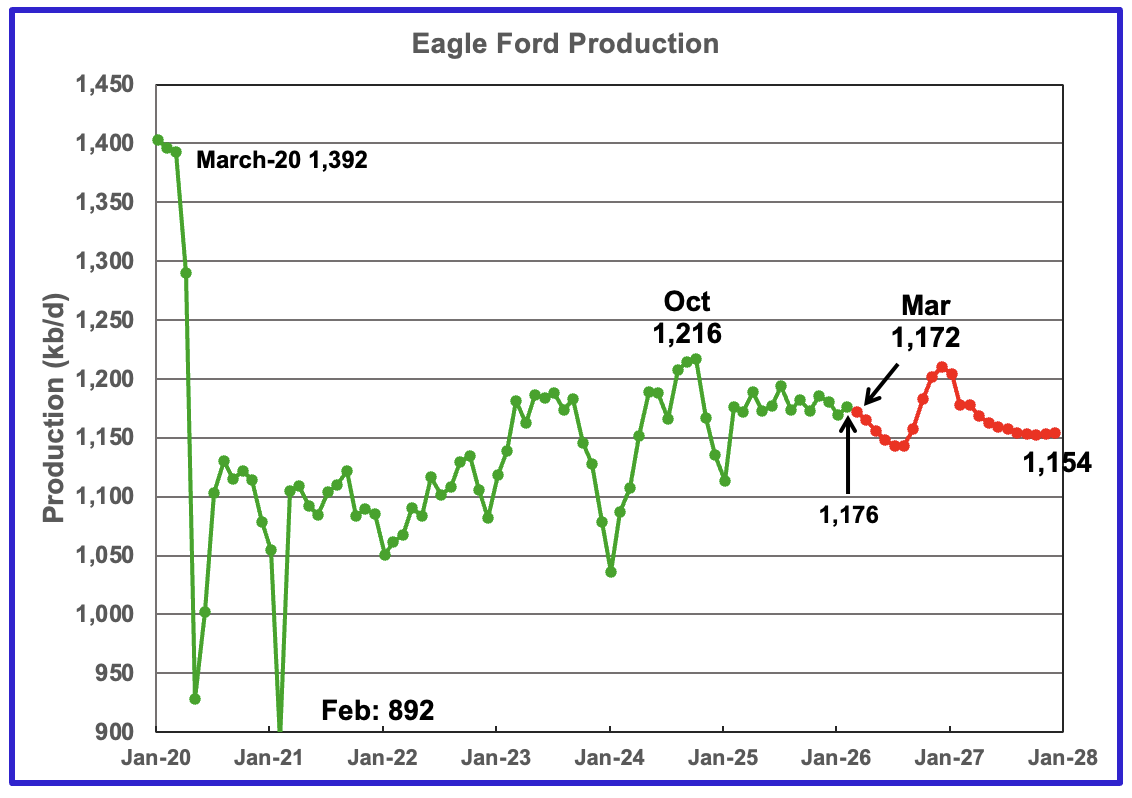
February’s output in the Eagle Ford basin increased by 7 kb/d to 1,176 kb/d. March’s 2026 production is forecast to drop by 4 kb/d to 1,172 kb/d.

Output in December 2027 expected to be 1,154 kb/d down 18 kb/d from March 2026.
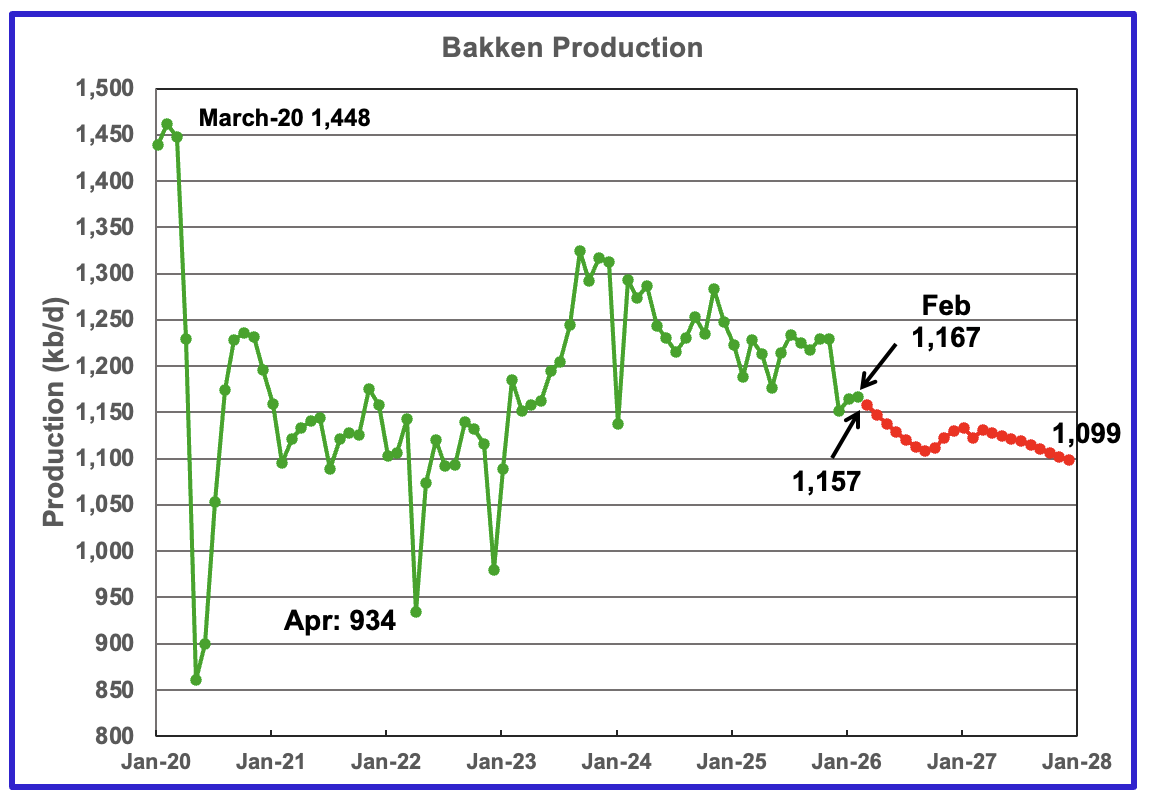
The DPR/STEO reported the Bakken’s February’s output rose by 2 kb/d to 1,167 kb/d. March 2026 production is expected to decrease by 10 kb/d to 1,157 kb/d. The STEO/DPR projection, red markers, shows output dropping to 1,099 kb/d in December 2027.
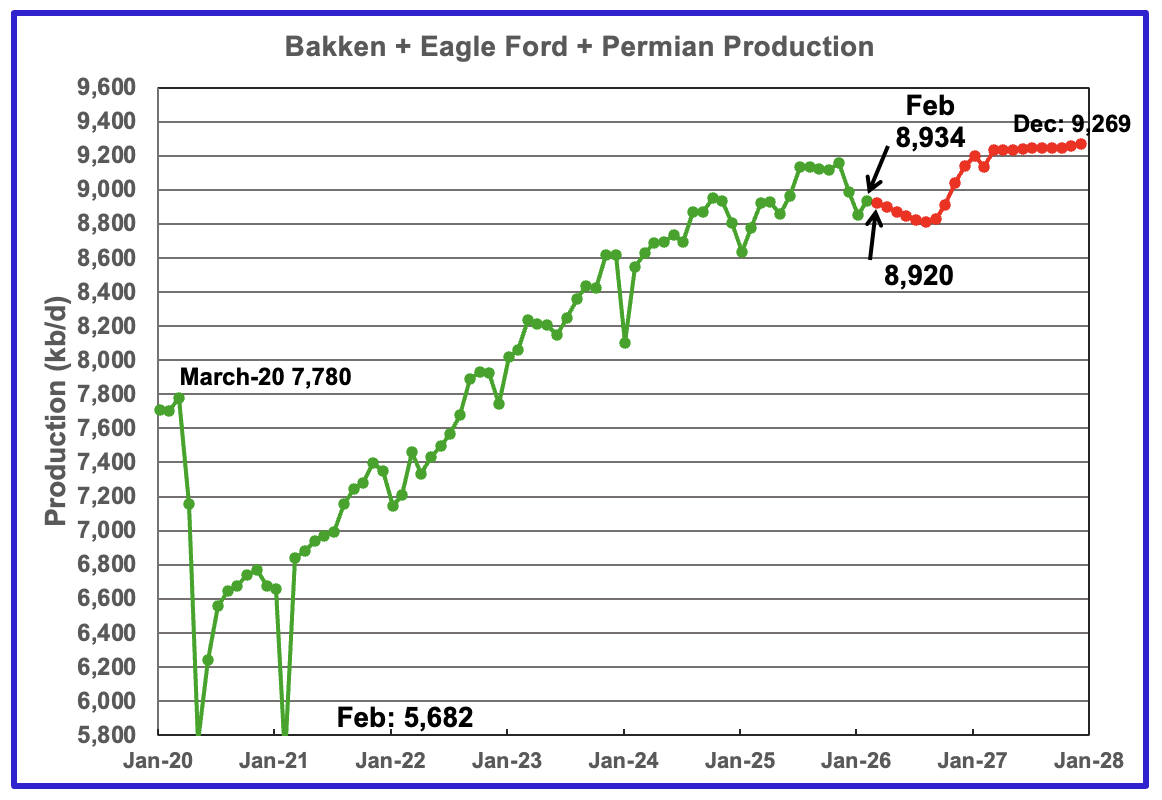
This chart plots the combined production from the three main LTO regions. February output increased by 79 kb/d to 8,934 kb/d. March is expected to drop to 8,920 kb/d. Production for December 2027 is forecast to be 9,269 kb/d.

DUCs and Drilled Wells
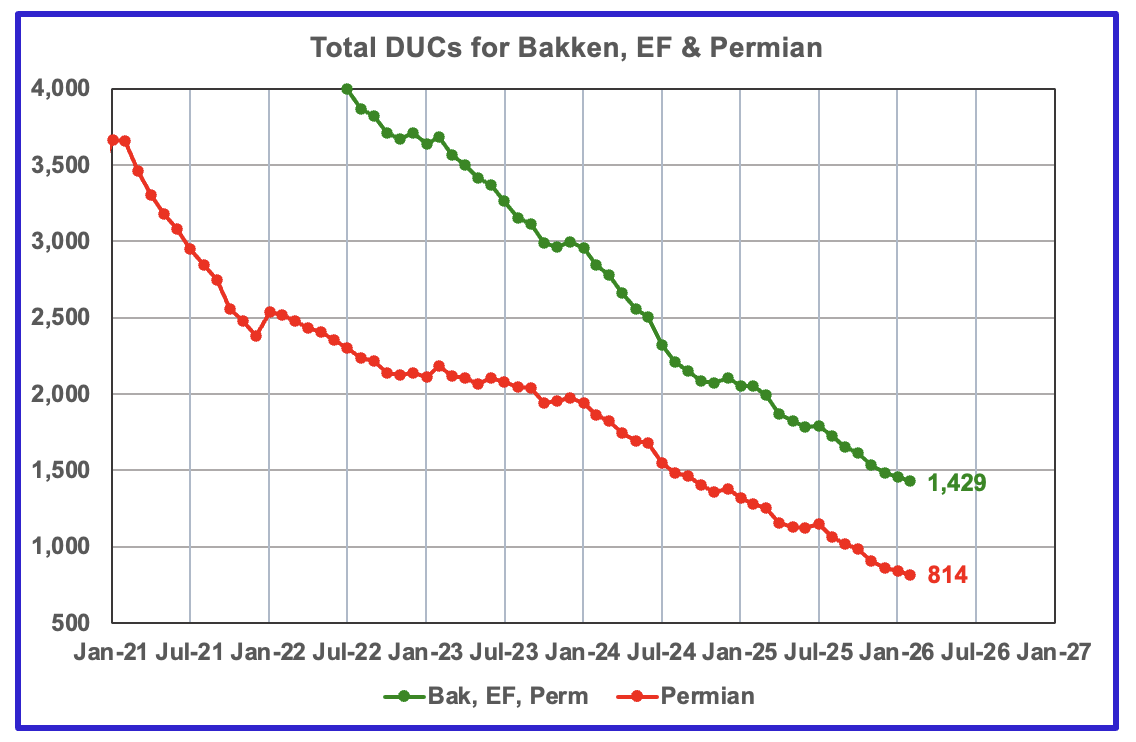
The number of DUCs available for completion in the Permian and the three major DPR regions continues its dropping trend. February’s DUC count for the three basins dropped by 29 to 1,429. In the Permian the DUC count dropped by 25 to 814.
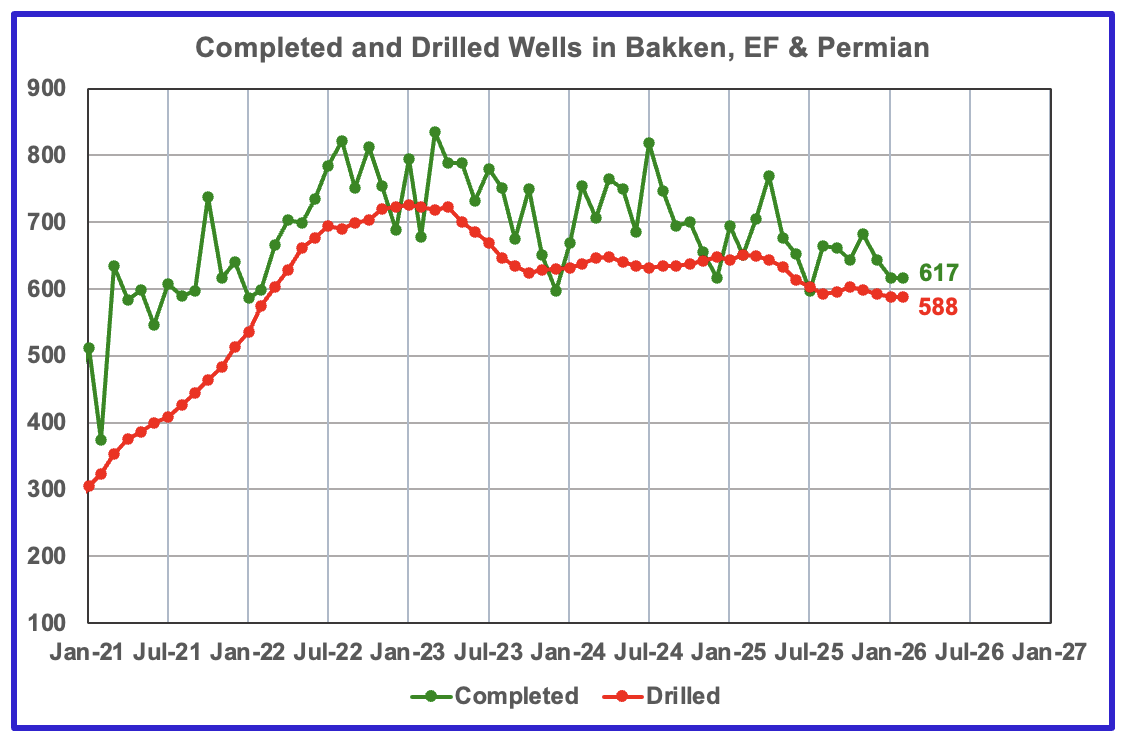
In the three primary regions, a total of 617 wells were completed in February, 1 more than in January. There were 588 wells drilled in February 2026, down 15 from October 2025 when 603 were drilled.
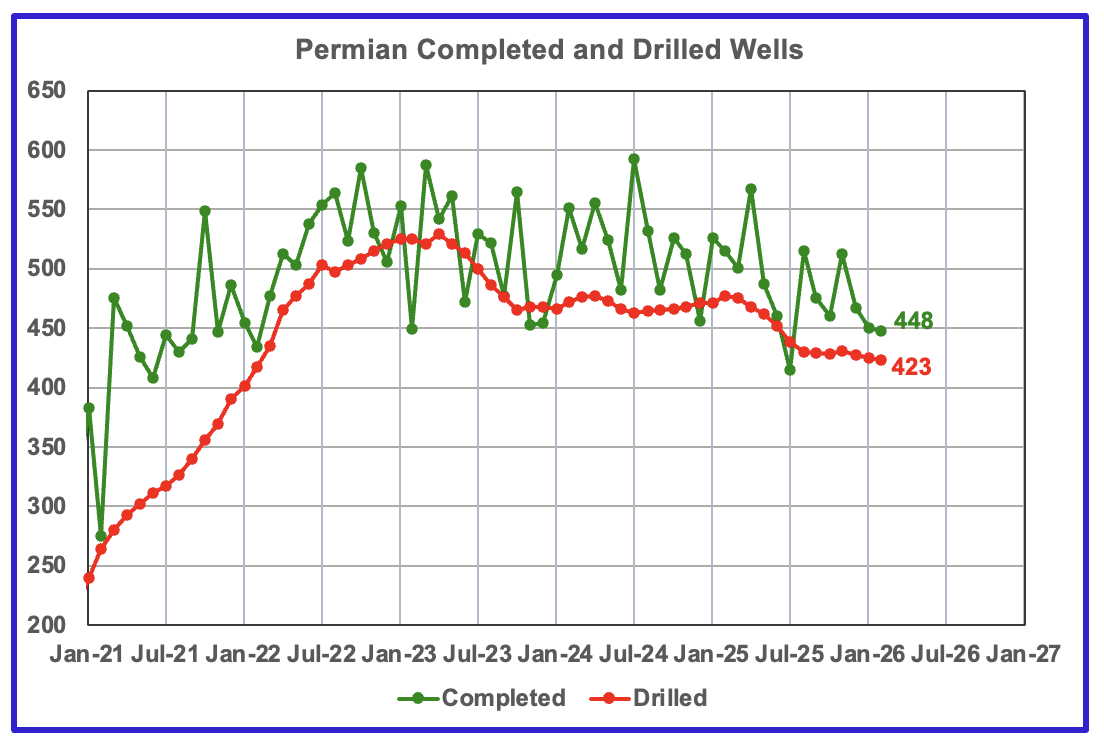
In the Permian, 448 wells were completed in February and 423 were drilled, both down 2 from January.
104 responses to “Weather Drops US January Oil Production”

  1. Ovi

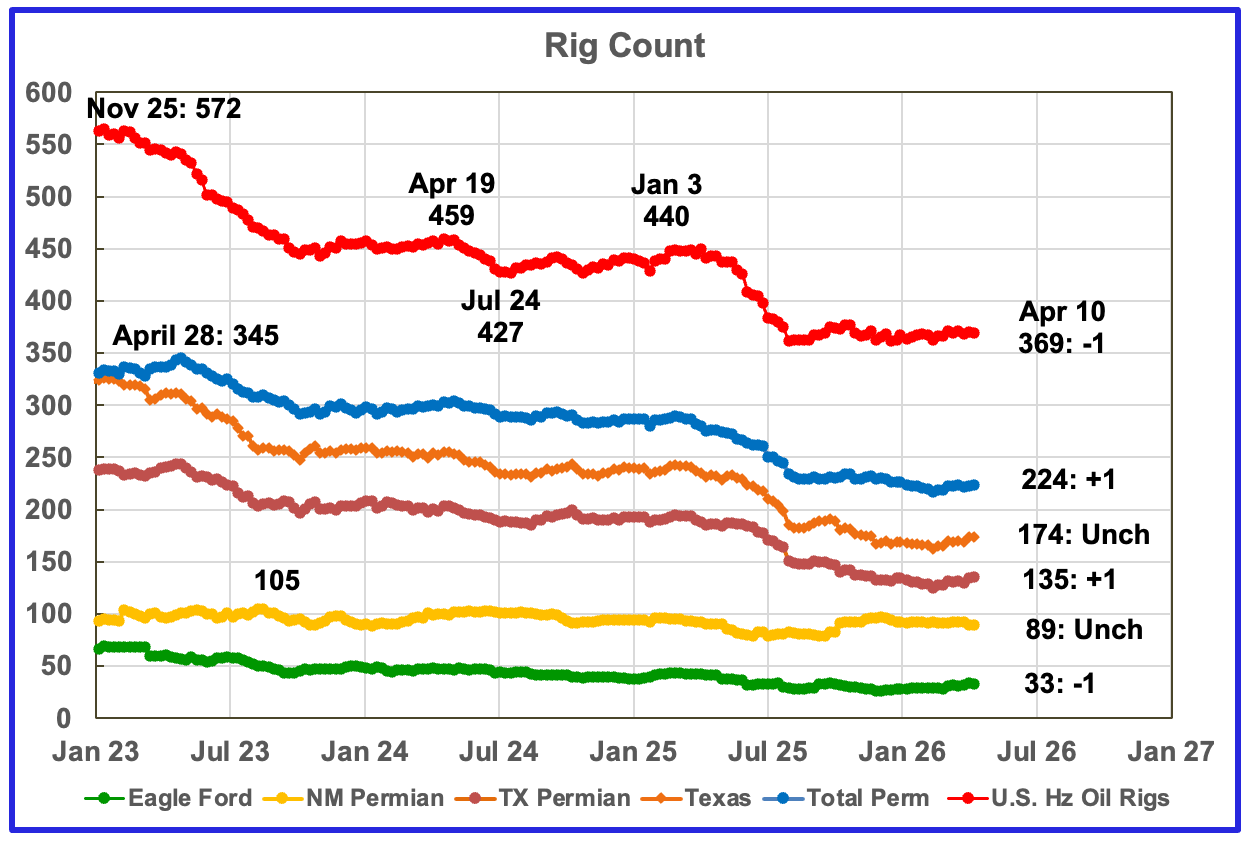
    Rig Report for the Week Ending April 2

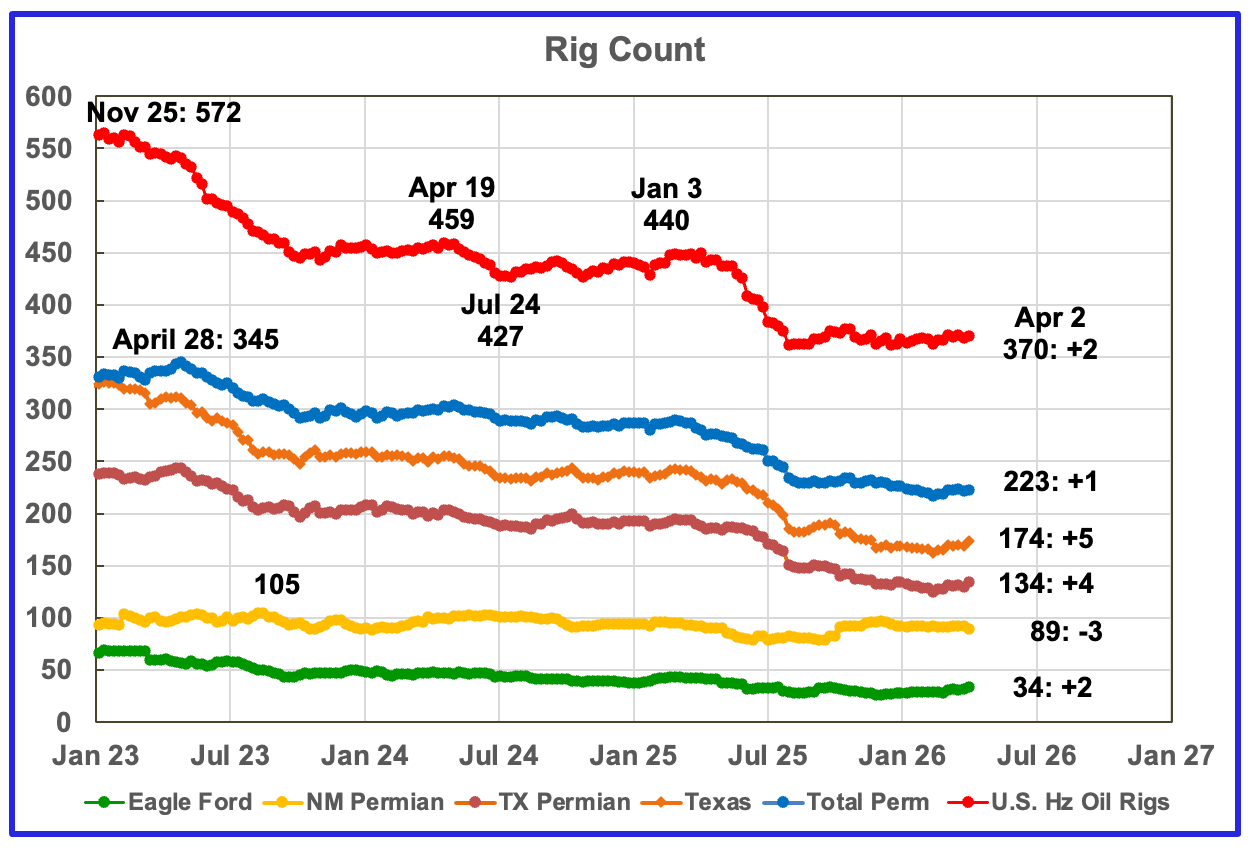
    The rig count drop that started in early April 2025 when 450 rigs were operating rose this week. Drilling continues at a steady rate of 367 ± 5 rigs per week since August 2025 while WTI closed just shy of $112/b.

    – US Hz oil rigs rose by 2 to 370, down 80 since April 2025 when it was 450. It was also up 8 rigs from the low of 362 first reached in the week ending August 1. The rig count is down 18% since April 2025.
    – The New Mexico Permian dropped 3 rigs to 89. Eddy dropped 1 to 36 while Lea dropped 2 to 53.
    – Texas added 5 to 174. Midland added 2 to 21 while Martin added 3 to 26. There were a few major rig shifts within Texas. Ector dropped 4 rigs to 5 while Reeves added 3 to 14. Upton added 2 to 13 and Karnes dropped 2 to 5. WTI rising may be affecting drilling decisions within Texas since there was a lot of internal shuffling.
    – Eagle Ford added 2 to 34.
    – NG Hz rigs added 1 to 113.

    A Rig

  2. Ovi

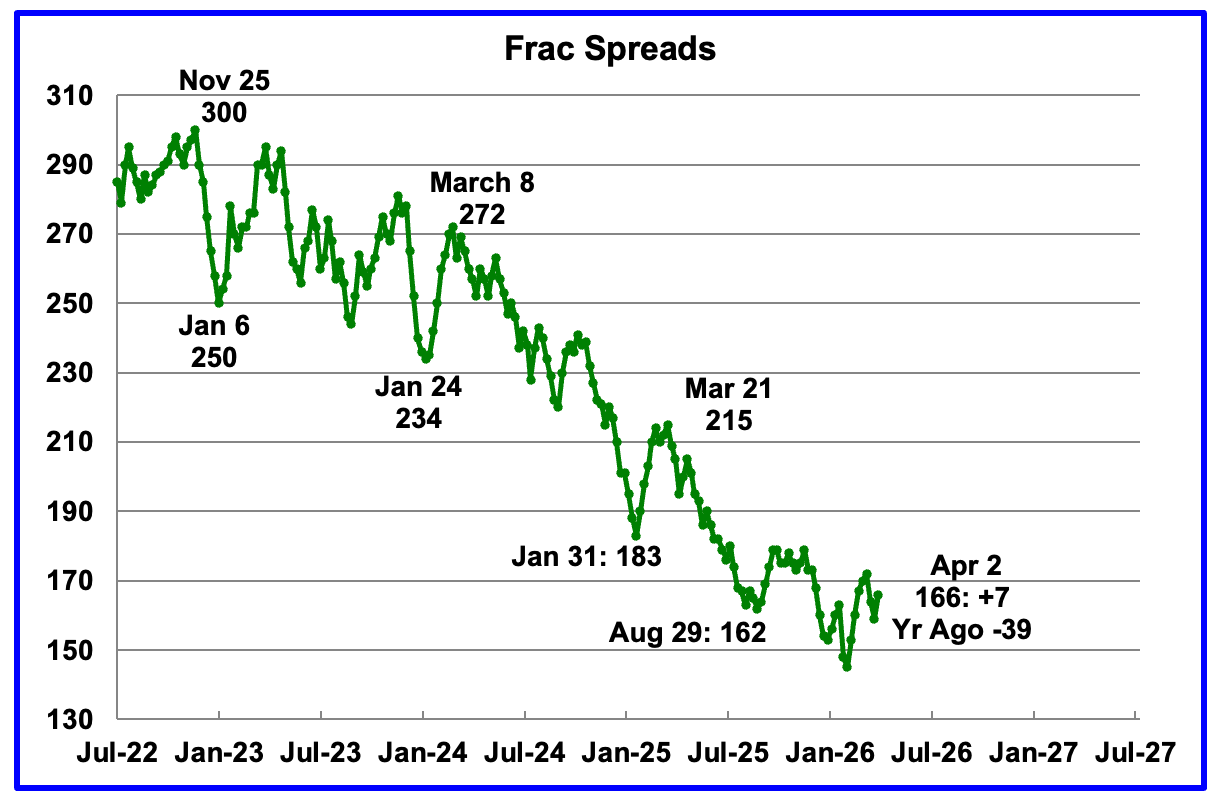
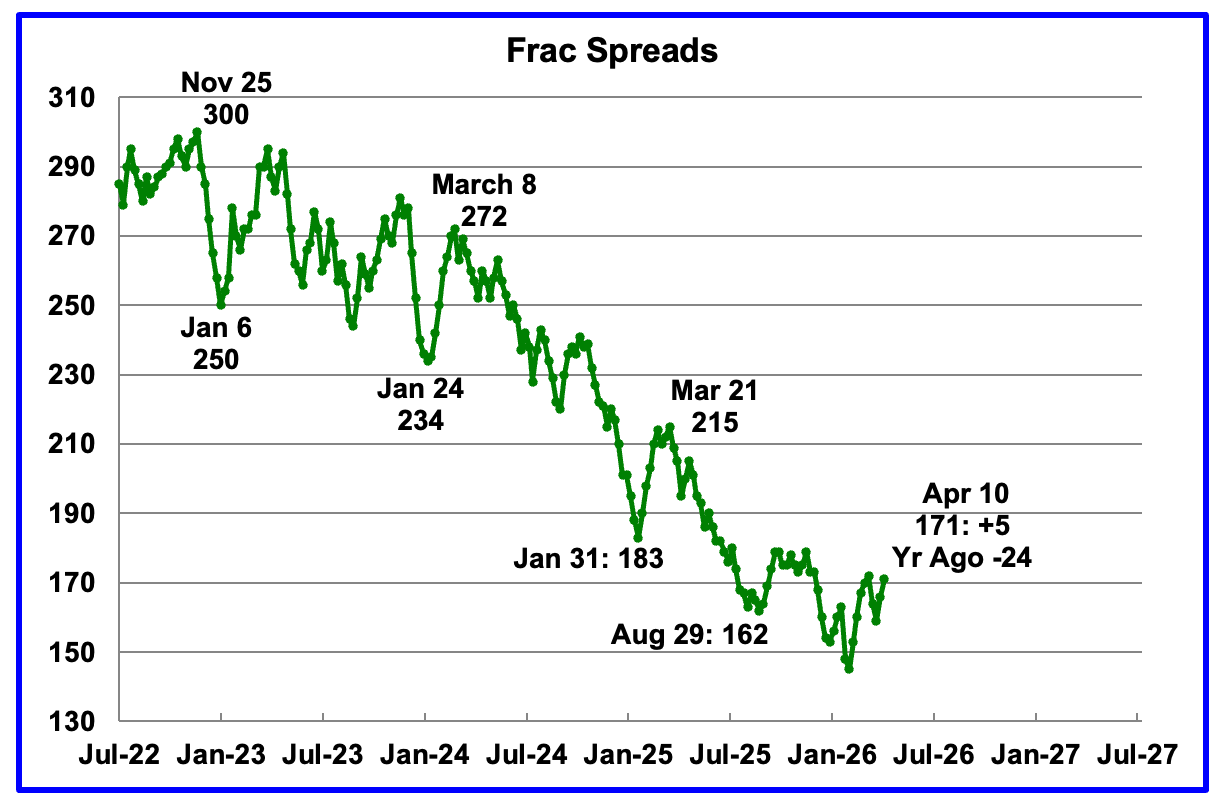
    Frac Spread Report for the Week Ending April 2

    The frac spread count rose by 7 to 166. From one year ago, it is down by 39 spreads and is also down by 49 since March 21, 2025.

    A Frac

  3. DC

    OPEC crude output down by 7.3 Mb/d in March from Feb. See

    https://energy.economictimes.indiatimes.com/news/oil-and-gas/opec-oil-production-crashes-amid-conflict-hits-lowest-level-since-june-2020/129939556

    That’s a drop of 8% of World output if not offset by increases elsewhere.

  4. Andre The Giant

    https://www.msn.com/en-ca/money/topstories/exclusive-russian-oil-output-cuts-are-unavoidable-as-drone-attacks-shrink-exports-sources-say/ar-AA1ZZAy7

    Russian oil exports continue to get hammered by Ukraine.

    Let’s not forget that the Ukraine is teaching the world about Asymmetric warfare.

    Relatively cheap drones attacking critical infrastructure.

    Every terrorist organisation on the planet is going to copy this strategy, if they can acquire the drones.

    1. Ervin

      The main terrorist groups were all given unlimited resources by Iran. That ship has kind of sailed and tomorrow cannot be assumed to be like yesterday.

    2. Nick G

      I think we want to mostly stop using the word “terrorist”. Here’s how it’s defined:

      “Terrorism is the unlawful use of violence and intimidation, particularly against civilians, to coerce governments or societies to achieve political, religious, or ideological goals. It involves premeditated acts causing fear, death, or destruction, commonly categorized into domestic (within one’s own country) or international (transcending borders) acts.
      FBI (.gov)
      Key Elements of Terrorism
      Violence/Threat of Violence: Use of dangerous acts (bombing, kidnapping, hijacking).
      Target: Often directed against civilians or non-combatants.
      Goal: To intimidate a population or influence government policies.
      Motivation: Driven by political, ideological, social, or religious motives.
      United Nations Office on Drugs and Crime”

      Sadly according to this definition the primary “terrorist” right now is the US government. The president is currently bombing civilian bridges and infrastructure, and threatening broad destruction of energy Infrastructure, and threatening to bomb Iran “into the Stone Age”.

      That’s “violence directed against civilians”, “To intimidate a population or influence government policies”

    3. Andre The Giant

      Asymmetric warfare with relatively cheap drones was my point.

      Sorry if I got the definition of “Terrorist” wrong.

      There is nothing that can be done to stop this on commercial vessels, In my unqualified opinion.

      Every chokepoint on the planet will be requesting FEES to pass.

    4. Nick G

      “ Every chokepoint on the planet will be requesting FEES to pass.”

      Takes you back several centuries. Have you read the first few pages of “A tale of two cities”? It describes highway robbery, which is kind’ve what you’re talking about…

    5. Andre The Giant

      https://www.youtube.com/watch?v=I8K5R6uZJPY

      Nostradamus Andre nails another one.

      The Houthies are going close their chokepoint in the Red Sea.

  5. T HILL

    Fossil fuels are obviously finite, but current events continue to drive home the significance of above ground factors on energy & oil in particular.

    Into the second month of closure for SOH now.
    – Per Kpler, 10.7mbpd production offline as of 3/20 with 11.5mbd forecast for end of march.
    – Per BBC, 42% of Russia’s exports temporarily shut down by Ukrainian attacks, or 1.8mbd
    – US SPR down 378,000 b for the week ending 3/27
    – Per Lloyds, “Tehran’s ‘toll booth’ system is now controlling Hormuz traffic’
    – Seeing some conflicting reports, but suggestion is that interception rates for Iranian ballistic missiles are dropping, perhaps significantly.
    – Multiple reports around significant depletion of key pre-war US/Israeli munitions stockpiles
    – Multiple reports around number of US/Israeli radar systems hit
    – Oil & gas facilities still being hit, with Mina al-Ahmadi struck by a drone yesterday.
    – Per CNN, US intelligence assesses about half of Iran’s ballistic missile launchers remain, that Iran still has thousands of attack drones, that Iran retains “a large percentage” of it coastal defense cruise missiles and that IRGC still has “hundreds, if not thousands, of small boats and unmanned surface vessels”
    – Iran continues to retain nearly 1000# of highly enriched uranium.

    This does not look promising for return to stable exports from SOH anytime soon. Global impacts created by the voting decision of less than 1% of global population. Sun Tzu indeed.

    Something like 2mbpd oil demand eliminated by EVs to date.

    Stats for simple correlation of global population with oil demand since 1950 continue to be arguably the best single predictor. R-squared above 0.9 depending on how you approach the data.

    1. Its not so hard now to see how this could devolve into a form of world war. Certainly an economic war that works to hobble the US. Economic war often precedes kinetic ones.

  6. Australia in trouble. Decades of complacency take revenge now

    4 Apr 2026
    Australian Diesel stock held in March 2026 declined by 10% in 4 weeks
    https://crudeoilpeak.info/australian-diesel-stock-held-in-march-2026-declined-by-10-in-4-weeks

    1. I wonder what the relative cost of switching some of the heavy transport to compressed nat gas vs rebuilding diesel refining capacity is? I suspect it would be much quicker and cheaper to engage in switching fuel source than to build a refinery.
      I see that you had brought up this fuel switch a long time back-
      https://crudeoilpeak.info/nsw-gas-as-transport-fuel-where-are-the-plans

    2. Andre The Giant

      Australia will move to Coal to Liquids after this.

      The Prime Minister requested citizens not to hoard fuel.

    3. Nick G

      Coal to liquids is very slow, expensive and capital intensive. We’re talking multi-billion dollars and at least 5 year construction times. It’s also very polluting, though Australia’s coal industry has enough political power to mostly suppress serious discussion of that problem.

      Far faster and cheaper to simply electrify transportation, both for passenger vehicles and heavy vehicles. Ethiopia has simply banned the import of ICE vehicles. Norway took a gentler approach: they long ago imposed heavy tariffs on ICEs to reduce oil consumption, but someone noticed that EVs don’t use oil and they reduced tariffs for EVs and…they took over in Norway.

      Individual Australian homeowners have moved to PV very, very fast. IIRC the utilities have moved more slowly, but it’s time for them to expand PV and batteries, and do it quickly to reduce domestic gas and coal consumption.

      There are a lot of on-site generators – they should be paired with PV and batteries to reduce costs quickly.

      It’s time to develop a robust vehicle retrofitting industry – that started during the last price spike 15-20 years ago, but faded away again. Rather than retrofitting to NG, better to electrify. IIRC You can place an electric motor in the drive shaft and connect a battery – not that hard. It’s probably time for commercial vehicles to install roof-top PV – I believe Australia requires that for new RVs.

    4. Ovi

      Hickory

      Switching a diesel truck to natural gas I think is a non-starter. There are so many changes besides the engine, adding 5 to 6 high pressure tanks is complicated. What is needed are OEM class 8 trucks and they have been on the scene for the last few years but have been a bit underpowered. Cummins has just introduced a higher powered 500 hp NG engine and Kenworth will start using those shortly.

      The timing couldn’t be better.

      In 1990 I lead a team that developed a natural gas powered 40 ft transit bus. Cummins agreed to develop the Heavy Duty NG engine and Orion Bus Industries built the Bus. Alussise supplied the high pressure NG tanks. Same situation as now. High diesel price and cheap NG.

      https://www.kenworth.com/about-us/news/kenworth-delivers-industry-s-first-15-liter-natural-gas-powered-truck-to-ups/

      https://www.cummins.com/en-na/news/2025/12/23/fabulous-year-cummins-x15n-natural-gas-engine

      https://www.ccjdigital.com/alternative-power/natural-gas/article/15772526/cummins-x15n-marks-return-of-natural-gas-to-class-8-trucking#/find/nearest?fuel=CNG

    5. Ovi, yes indeed. It seems that many transport companies in a country like Australia will be a good customer for the cummins X-15 rather, than waiting for a big centralized and expensive project like a refinery or coal to liquids industry.
      There are quite a few international manufacturers of nat gas truck engines.

    6. kolbeinih

      Australia is way too energy rich to be having real problems. So it is more what is more cost effective short term or long term. Long term I would suggest using ships to provide energy needs as the best solution. Renewables works well enough in the population centers to make up a major part of the electricity grid.

      But I do support the notion of having natural gas supported trucks. It is convenient when it comes to domestic resources and when it comes to the interior. Even natural gas propelled trains. Anything cost efficent would do I guess. Coal to liquid, diesel, gas, natural gas compressed or even imported wood – anything would do to keep the wheels on as long as it is cost competitive. That is the spirit of short term thinking.

    7. Andre The Giant

      Beetaloo Basin…The Coober Peddy

      Absolute mismanegement by the Australian government…..

      Lets trust the Middle East, China and Japan ( who tried to invade Australia in WW2 )

      with fuel supplies…..

  7. Dated Brent is close to $140/barrel which is the current real price of oil. The fact that next month’s Brent is only $110 is that financial markets have not yet understood that there is no simple solution to the USrael Iran conflict.

    There are two important aspects about military conflict which are not often
    covered in the movies: propaganda and logistics.

    Propaganda is important because governments that go to war have to convince
    the population to pay the economic and human costs of war as well keep up
    troop moral. In any war, governments lie through their teeth. The standard
    procedure is to vilify the enemy (to justify killing them), to downplay
    the costs of the war, and to claim they are wining. For example in WWII the
    U.S. incurred 200,000 casualties while inflicting 65,000 on the enemy. These
    statistics were of course vastly distorted by the U.S. government until
    after the war.

    Logistics are important because without food and munitions soldiers are
    ineffective.

    There are 3 countries in the world with hypersonic missiles: Russia, China, and Iran. Hypersonic missiles and drones dramatically increase the home court advantage because they considerably complicate logistics for the attacking army. USrael has a 9,000 kilometer supply line. US warships are forced to loiter outside the range of Iranian anti-ship missiles and drones. Look at a (relief) map of the straight of Hormuz. There is no way USrael can take control of this straight with military means.

    Currently the straight is filtered. Ships can go through if they pay Iran the equivalent of $2 million in petroyuan (oil must also be paid for in petroyuan). Once financial markets figure out that there is no military means of opening the Straight of Hormuz, watch the bond market.

    The petroyuan is a useful currency because you can buy oil from the Persian Gulf with it.

  8. careful with your facts-
    “Approximately 2.1 million Japanese combatants died during the Pacific Theater of World War II, with the vast majority killed in actions against U.S. forces.”
    “Approximately 111,600 U.S. combatants were killed or missing in action during the Pacific War against Japan.”

    I do not mean to diminish the other points you are making.

    1. Thank you for the correction. I think the numbers I gave related to the European theater. Wikipedia puts the number of U.S. casualties in the European theater at 250,000. I simply quoted numbers from Col. Douglas Macgregor. Wikipedia says there have been recent revisions to estimates.

    2. Nick G

      Hmm. Got to be careful with casualties (“ A person unable to serve due to death, injury, sickness, capture, or being missing in action.”) vs deaths. I believe Wikipedia gives 250,000 *deaths* in Europe in WWII. Casualties will be very roughly 2.5x higher, in the neighborhood of 625,000.

    3. Nick G

      The ratio of casualties to deaths can change: lately US armor has gotten better, so deaths have declined while injuries stayed the same which significantly raises the ratio.

    1. Andre The Giant

      https://www.youtube.com/watch?v=pPLaVGkzYS4

      5 minutes

      A deeper discussion of this

  9. Seppo Korpela

    From O&G Journal, capital spending for 2026 to be 110.2 billion down from 114.1 billion in 2025.

  10. Ralph

    Two week ceasefire agreed between US, Israel and Iran . All attacks to stop, Iran to militarily coordinate ‘free passage’ through the strait. Details to follow. B52s en route were recalled. Gulf countries report Iranian missiles arrived after the ceasefire announcement. Israel had already bombed some civilian bridges and substations.

    Negotiations to begin Friday.

    Update

    Israel has already contradicted Trump and Iran, and will continue attacking Lebanon. The chances of this ceasefire holding or even starting are low

  11. Ralph

    Much as I expected, the strait remains firmly closed to any ship not given explicit permission to travel by Iran, presumably permission involving close ally status and/or a lot of money. Israel continues to bomb Lebanon, at least 100 innocent deaths today alone. Also, reports that Iran is still attacking Gulf state infrastructure.

    Trump has declared victory and left. In all other respects the war continues and Iran has its hands around the throat of the world economy. It is still a better outcome than the alternative.

    This is the biggest strategic defeat for the USA since , er, 250 years ago.

    1. Nick G

      It’s a dramatic defeat for this president. I think serious people everywhere are hoping that he is an aberration. We can hope that all of his chaos will be attributed to him and not the US in general.

      Other results:

      -Oil producers outside the M.E. will enjoy much higher income for a while.

      -Saudi Arabia and Israel are happy that Iran’s military is degraded.

      -renewable energy and EVs will get a very large boost for the long-term.

  12. Layman

    As a semi-frequent reader but rare commenter, I find the whole “is peak oil political?” discourse silly.

    The truth is, everything is political. And in my lifetime, as a “young” man by y’all’s standards (i’ll be 39 soon! That’s nearly 40!) American conservatives have fought against higher fuel standards and hybrid cars and public transit for literally my entire life. So they are far more to blame than Liberals or Leftists, objectively. At least in context of the ol’ US of A, the most important country ever, according to themselves.

    The REAL problem with America, is the way our cities are designed. We deserve better public transport AND better mileage for our vehicles. Is this sufficient to solve the oil crisis? Of course not, but it would be a hell of a lot better than what we have now.

    1. T HILL

      Layman,
      I’d agree with much of your post, but would quibble with some aspect of your last paragraph.

      Cities in the US are not ‘designed’ in the sense of starting with a blank sheet on a drafting table that is organized from scratch. The process is more organic and much less organized than that. Multiple levels of government with different levels of responsibility and control, multiple local government jurisdictions, a range of private property actions, legal constraints, etc.

      Urban areas do see more than a third of US VMT, and post WW2 growth has indeed been heavily influenced by available transportation modes. That is certainly political, particularly as it relates to i) the oil/gas vested interests and the electeds and party they support, and ii) what funding is available to “planners” and what the constraints on the funds are. One of the most recent, examples of this tension is the republican administration efforts to roll back the NYC congestion pricing program that is intended to provide funding for the MTA capital program. At the US federal level, Republicans have certainly opposed CAFE standards, with the current administration actively rolling back standards from a roughly 50mpg target for 2031 to 34.5mpg.

      I always think about the Upton Sinclair quote that … “It is difficult to get a man to understand something, when his salary depends upon his not understanding it.”

    2. LeeG

      my $.02 is that taxing fuel is a better route to efficient use than mpg mandates. As it is we have 60 yrs of misc policies that carved out inefficient light trucks for daily commuters plus undertaxed gasoline so as to make those inefficient vehicles cheaper to run. Also undertaxing gasoline robbed funds for public transportation as deficit spending replaced pay as you go fuel tax.
      Having very high efficiency vehicles plus low cost fuel makes high mileage driving more common.
      Maybe it’s like high oil prices. The solution for high oil prices are high oil prices.

      Btw everyone likes a free lunch, conservatives, liberals or martians. Our predicament is mostly human. Living in a couple century old explosion of fossil fueled growth has shaped our world view more than left/right pigeon holes.

    3. Nick G

      LeeG,

      MPG mandates are better than a fuel tax, because new vehicle buyers are pretty insensitive to efficiency: they tend to be high income, and they have a lot of different things to balance when buying a vehicle. Most people drive used cars, and they are left with the choices made by new-car buyers.

      OTOH, MPG mandates don’t’ work well alone. They need fuel taxes to encourage better use of vehicles. So….it’s not one vs the other: we need both.

      One other thought: we don’t need fossil fuel to have a familiar kind of prosperity. I think we have enough “stuff”, and it’s time to look to other sources of happiness, but that’s a different story. We’re not faced with a predicament caused by our current reliance on FF: we can kick the habit.

    4. Alimbiquated

      T HILL
      In fact practically every American city mandates that most of its land be used for single family housing units with a minimum lot size. In addition, nearly every American city strictly forbids human habitation of “commercial” areas, preventing anyone from walking to a corner store. Even bars have parking minimums, though drunk driving is officially frowned on. In addition, nearly every American city mandates parking minimums for all sorts of buildings, and provides large areas of free on-street parking as well.

      It’s well known that when you pay a buck for gas, you’re paying 85 cents to heat the radiator. What people think about less is that when you drive through town, about half of the trip is past car infrastructure.

    5. T HILL

      LeeG

      Can you clarify your comment about free lunches? I’m not seeing the direct link to any of the points under discussion.

    6. LeeG

      THill, I’m not a clear speaker sometimes. I was responding to Layman’s comment that American Conservatives have been the impediment to more efficient use of fuels and my perspective is that partisan politics is a rounding error compared to immediate costs and rewards of fossil fuels. Fossil fuels are a free lunch. Yes it takes a lot of work to extract, refine and use it but over a few millenia of recorded history and a few hundred thousand years of our species they are a free lunch. My great grandfather was a farmer who started with draft animals and human muscle. My grandfather started with diesel and mechanized economy for his farm. My dad was an oil engineer.
      The significance of fossil fuels in our species expansion on the globe and the actions needed to survive the consequences of combustion aren’t defined by US politics. I look at the decades of policy that made the F150 a common commuter vehicle and I see the consequence of American policies. A protected market, tariffs, sched 179 tax incentives, CAFE, etc. Everyone gets a little freebie to make what was a farm vehicle into an urban lifestyle vehicle where efficiency is a low priority. Here we are 2026 and the GD Fed Fuel Tax is stuck at 18.4 cents since 1993 and the Highway Trust Fund shortfall is balanced w deficit spending. That’s insane.

    7. “The REAL problem with America, is the way our cities are designed”

      Aye. IMO, the urban environment in most cities is boxed in by freeways, railways, cul-de-sacs, and rivers. It’s not uncommon for a human-propelled commuter to have to travel TWICE the distance as a car because of impassable boundaries. I know because that was my dilemma for years — I was boxed in by a freeway going over a railroad hub on two sides, with crossings few and far between. Partly because on the other side of the railroad is the Mississippi and crossings of that are rare.. So instead of taking 15 minutes to bike to work, it took 1/2 an hour.

      The most ridiculous part of this predicament was that the Main St bridge (which runs parallel to the RR tracks) over the freeway was perfectly passable by humans, yet the city planners decided to ADD a second pedestrian-only bridge right NEXT to the Main St. bridge over the freeway INSTEAD of creating a path that could snake under the railroad tracks alongside the freeway, allowing human traffic over the river and the nice parks along the riverbanks. This was a multi-million $ boondoggle that didn’t solve any problem.

      So by car it took 10 minutes to get to work and by bike it could take 15 minutes. There’s a reason for the expression “the other side of the tracks”.

    8. “We deserve better public transport AND better mileage for our vehicles”

      And the North Star light commuter rail stopped service along the tracks that I was discussing. This was a multi-billion$ waste that only lasted for 20-25(?) years IIRC. The extra pedestrian bridge may have been created to make access to the train stop easier.

      shortcut map:
      https://imagizer.imageshack.com/img924/6674/lEiLIc.jpg

      The red Xs are the useless pedestrian bridge, and the green arrow is a hypothetical path that could snake under the railroad bridge to get to east River Road by foot or bike.

    9. T HILL

      Paul,
      What am I missing? It appears that the vehicular bridge carrying Main St over I694 lacks sidewalks and has narrow shoulders. The parallel pedestrian bridge provides a safer crossing for ped traffic and serves ped generators/destinations on both sides of the interstate corridor that you and others note is a barrier to some modes. It is likely ADA compliant. That has the special role in the US of law, not merely a standard or spec. This type of pre-fab steel truss is a common and cost effective solution for ped crossings. In this case, the ped bridge alignment is outside of overhead utilities thereby avoiding costly relocation. It also avoids things like increased dead load impacts to the existing vehicular bridge and all sorts of other complications that matter in the physical world. Infrastructure in an urban environment is complicated and costly. More importantly, resources are constrained. The costs of embodied energy in the built environment are very directly impacted by declining EROI across oil, gas and coal.

    10. “What am I missing? It appears that the vehicular bridge carrying Main St over I694 lacks sidewalks and has narrow shoulders. “

      It was perfectly fine the way it was. It’s actually more dangerous now because people have to cross that road from the perpendicular street to get to the ped bridge. I use it all the time and just stick to Main Street crossing the bridge going north. Going south I also stay on the Main bridge because I can make a smooth left turn. Totally unnecessary construction

      A bike lane is a sidewalk that doesn’t have a curb. LOL.

      BTW, Minneapolis is not Boston. You don’t take your life into your own hands when you walk or bike.

  13. T HILL

    Alimbiquated,
    Can you cite your sources for your claims? I’ve seen you make this same claims here before and remain skeptical that they are correct.

    At a minimum, land use within US cities includes commercial, industrial, institutional, recreational, open space, residential and transportation uses. Are you conflating the portion of residential properties that are zoned for single family use with the total space used for residential purposes?

    Are you also suggesting that 50% of land use in cities is for roads and parking lots? This number also seems questionable.

    1. Alimbiquated

      T HILL —
      City zoning maps are available online. There is no central repository showing percentage of areas by zone for all cities, mostly because there are too many variations in detail to allow easy aggregation. Other highly restricted zones like “duplexes allowed” are sometimes mixed in.

      These areas usually ban all commercial activity and have mandates on lot size, which increase the distance from the average house to the nearest store. That is why Americans drive to the store.

      Do an image search of “zoning map” to get an impression. Single family residential is usually light yellow.

      In city centers usually a third or half the area is dedicated to various car infrastructure. This is a guide:

      https://parkingreform.org/resources/parking-lot-map/

      Cities also have setback regulations, which are government mandated conversion of private land to further widen roadways.

      Another aspect that is plainly visible but hard to measure in aggregate is that introducing loud, dirty and dangerous high speed roads in crowded areas reduces the viability of nearby land for any human use. The amount of derelict and semi-derelict land in American cities is shocking. People just drive by without noticing, and statisticians have difficulty calculating it. Look at the discussion of I345 in Dallas or the Inner Loop in Rochester for more thoughts on land use issues.

      It’s really bizarre how little interest American cities take in land use. Land is their only asset. Consider the “red zones” in California. These are patches of usually urban land where no vehicle is allowed to drive or stop. They are off curb, so off limits to pedestrians as well. There are literally millions of these in California cities. So what are they for?

      Even densely packed cities like New York waste space flagrantly. All those yellow-painted median strips, streets meeting at a slant instead of curving to meet at right angle, and useless triangles just waste space. It gets even wilder in place like Phoenix, which has easily twice as many parking places as people.

    2. T HILL

      Alimbiquated

      Thanks for the reply.

      For my sake, I’ve little interest in geology, industry tech or making a buck on oil. My interest is in the consequences on both sides of the faustian bargain that we’ve made with oil and other fossil fuels. That’s my lens for most of the discussion on this board and for this land use issue. Some of the assumptions that are currently popular within urban planning are not well supported by facts. For example, consider:

      Jones & Kammen (2013), Spatial Distribution of US Household Carbon Footprints Reveals Suburbanization Undermines Greenhouse Gas Benefits of Urban Population Density

      Mindali, Raveh & Salomon, (2004) Urban density and energy consumption: a new look at old statistics

      Wackernagel et al (2019), Defying the Footprint Oracle: Implications of Country Resource Trends

      Eaton, Hammon & Laurie (2007) Footprints on the landscape: An environmental appraisal of urban and rural living in the developed world

      Moran et al (2018), Carbon footprints of 13000 cities.

      Yuan et al (2021) A global overview of developments of urban and rural household GHG footprints from 2005 to 2015

      Connolly et al (2022) Urban and rural carbon footprints in developing countries

      Minx et al (2013) Carbon footprints of cities and other human settlements in the UK

      Paravantis et al (2021) A regression analysis of the carbon footprint of megacities

      Rees, Why large cities won’t survive the twenty-first century

      Grubler et al (2012) Urban energy systems

    3. Nick G

      T Hill,

      How do the conclusions of these studies change if we stipulate that FF can be replaced by renewables and electrification?

      For instance Rees’ study seems badly out of date – it’s just old fashioned PO analysis: the idea that PO will cause transportation to fail is simply unrealistic.

    4. T HILL

      Nick G,

      No, the body of work by Rees is very much not an old fashioned PO analysis. He is an ecologist and one of the creators of the ecological footprint concept. Ecology is his primary lens. His perspective is much broader than only oil. Yes, he certainly does discuss fossil fuels given their significant impact.

      Much of the rest of the cited work speaks to the relative resource use demands of land use across the spectrum from rural to urban. Many of those resources are or use energy sources and have associated carbon impacts. Their predictions about carbon impacts would change if the underlying energy mix changed, but their core conclusions about resource intensity and sustainability seem less likely to change.

      While your suggested stipulation may (?) be possible in theory, in practice it does not appear at all likely that renewables will replace fossil fuels and maintain the status quo. The evidence to date certainly argues against it.

    5. Nick G

      T Hill,

      It looked to me like Rees’ analysis depended heavily on the proposition that energy supplies would be inadequate to supply large cities.

      So…will the political power of FF industries prevent the level of reduction of CO2/GHG emissions required to prevent major climate change? Perhaps. But given the level of adoption of renewables and electrification we’re seeing around the world, it will certainly not prevent sufficient buildout of renewables to prevent major, longterm energy shortages.

      So, it seems entirely unrealistic to suggest that large cities will be untenable due to energy shortages.

  14. Looks like the Oil Shock Model is on Grokipedia, which is an AI version of Wikipedia

    https://grokipedia.com/page/Oil_Shock_Model

    Someone familiar with Wikipedia ought to create a Wiki page for the Oil Shock Model. You will probably ask — “Why don’t you do that?”. Well, the rules are such that authors are not allowed to contribute their own work, and if you try the editors will remove it accompanied by a snarky comment. In contrast, the Grokipedia content is automatically generated by the grok LLM by searching through published texts and online sources.

    This is particularly timely stuff, as the Iran/USA/Israel war is creating quite a shock to the system.

  15. shallow sand

    Dennis and Ovi:

    Do either of you have any reliable data on worldwide oil inventories pre-Iran War, as well as how much those have been drawn down to date?

    I have read many articles on this and it seems the numbers vary greatly.

    It seems that around 7 million BOPD was lost in March. So that would imply approximately 217 million BO drawn down, less the amount of demand destruction, which seems difficult to determine at this time.

    Commentary: I see no reason why Iran would relinquish control of the Strait of Hormuz as long as it can export all of its oil. Iran needs a very high oil price, and control of the Strait of Hormuz gives it this ability. There is no appetite for a high casualty, long duration ground war and occupation in the USA, so it appears Iran is in a very strong position.

    1. I agree with your commentary. I’ll add that the US will have a very hard (unpopular) time sanctioning or blockading Iranian oil exports in a world where there is otherwise a shortage of oil for export. Oil importing countries would be/are in an uproar, as would the other Gulf exporting countries (who will likely suffer further export degradation capacity).

      It looks to me like this ‘chess’ game played by the US will go down as the worst conceived in recorded history.
      I’d like to be favorably surprised by some outcome that I now fail to foresee.
      What would be favorable, compared to the conditions prior to this action?
      -Iran gives up on its nuclear program, and on its ‘crusade’ to remake the region/erase Israel from the map.
      -Iran does not control the straight of Hormuz, or earn money on it.
      -Iran is rewarded for ‘normal’ behavior with relief of sanctions.

      I do not see the result of this ‘epic fury’ as having any chance of achieving those kind of results. Sorry, but this looks like a massive fail for the US, and a very big economic hit to dozens of countries. The loss of US standing among nations looks to be huge, a voluntary loss.

      Good for Russia, and for China.

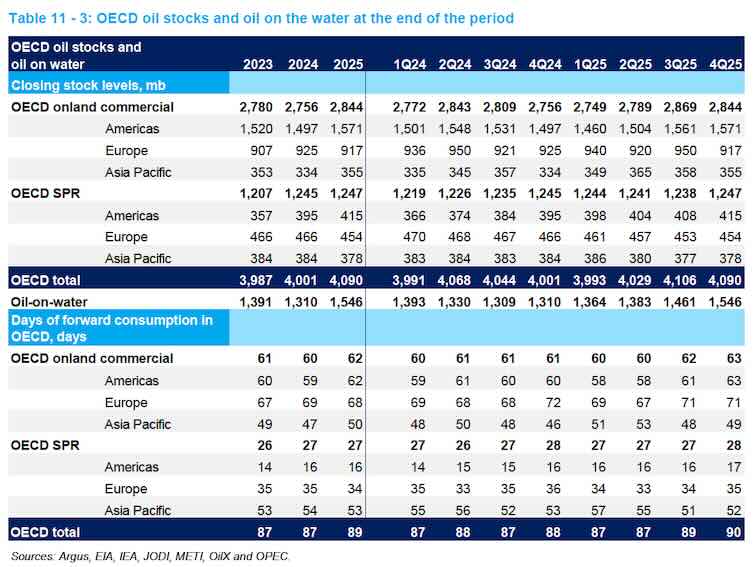
    2. Ovi

      SS

      Attached is the latest Table from the OPEC March MOMR. The April report comes out next Tuesday. As you can see Oil on water was the big gainer in Q4-25.

      I will try to find something more up to date.

      Screenshot

    3. DC

      Shallow sand,

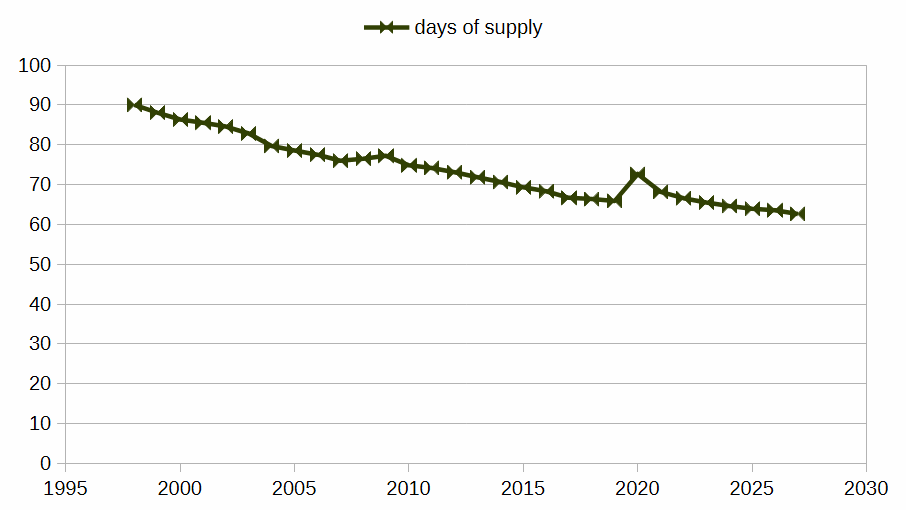
      The best guess I have is based on STEO international production and consumption of crude.

      See https://www.eia.gov/outlooks/steo/data/browser/#/?v=6&f=A&s=0&start=1998&end=2027&linechart=PAPR_WORLD~PATC_WORLD&maptype=0&ctype=linechart&map=

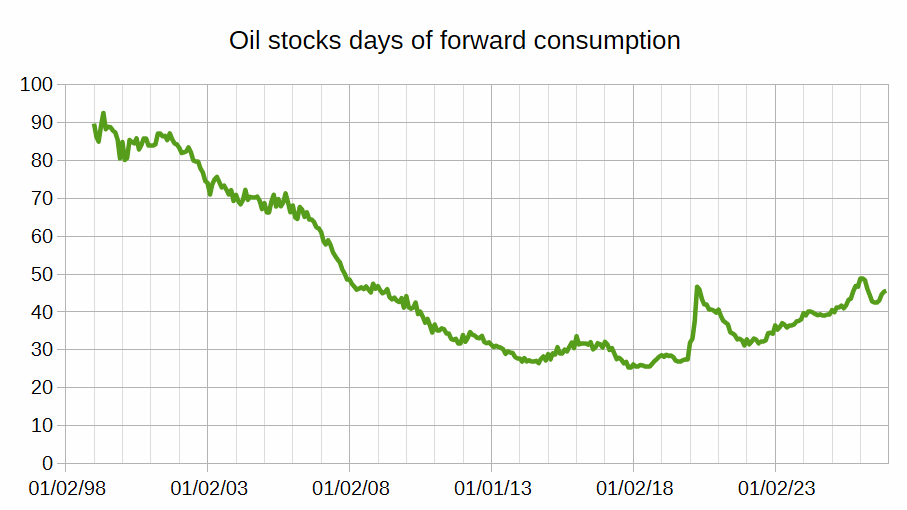
      One could assume at the end of 1998 there was a 90 day forward supply of petroleum liquids stocks (a guess by me). If that assumption is correct we would have the following for World oil stocks, see chart linked below.

      world stocks oil

    4. Nick G

      “There is no appetite for a high casualty, long duration ground war and occupation in the USA”

      I think that’s true. But, there seems to be a question that’s left unanswered, on the edge of our awareness, which is: *should* people in the US have an appetite for such a war?

      We have a president who campaigned on no foreign wars. More importantly, we have a war which has never been clearly, coherently, consistently explained. Many commentators who seem credible question the idea that Iran was a real danger, either to the US or to its neighbors. They question whether Iran would really try to destroy a nuclear-armed Israel, as opposed to nagging at it by supporting hostile movements in neighboring areas. They question whether Iran was anywhere close to developing a nuclear weapon. It seems clear, at minimum, that Iran was not a clear and present danger to the US, which is what’s required to make a unilateral declaration of war legal and legitimate.

      We’ve already had a major war with Iraq, where the Bush administration falsified evidence of WMD. We have a president who clearly relies on bad sources of information. We have a government in Israel which many believe is pursuing policies which are unrealistic and harmful to the long-term interests of Israel.

      There is an argument that the current government of Iran is bad, and should be changed. Well, I agree that it’s bad, but there are 2 questions here: is it bad enough to justify intervention, and if so can it be done? I doubt the answer to the first is yes, especially given that most of the hostility of the Iranian government is due to the fact that the US has done this before: in 1954 the US toppled a new democracy and installed a dictatorship! This was an enormous mistake. And, the answer to the 2nd is probably no, the US can’t install a new government – that’s what we’re seeing now. It would take an enormous, almost genocidal war to do it. We tried that in Vietnam, and even that didn’t do it.

      It’s worth noting that the architect of the Vietnam war, SecDef Robert McNamara, ulitimately declared that the Vietnam war was a mistake, and not justified. How many bad wars are we going to fight?

      I think there’s a pretty strong case that this is an unjustified war.

    5. DC

      Ignore my previous chart on oil stocks, I made an error in calculation.

      The chart below assumes 90 days of forward consumption at the end of 1998 and uses monthly data for days of forward supply from STEO.

      oil stocks

    6. shallow sand

      I’ve read US Naval Ships have went through the Strait of Hormuz into the Gulf. Wow!

    7. Andre The Giant

      The idea the US Navy can’t travel through the Strait is preposterous.

      They’ve been doing it for decades.

      They will scoop up the mines that Iran laid and plant them in the Iranian leaderships backyard.

      With a Birthday Card….

      Iran closed the Strait to commercial vessels.


      The US Navy does whatever it wants over there.

    8. Kleiber

      No, the USN did not transit the strait.

      https://www.msn.com/en-us/news/other/reports-dispute-defense-department-account-of-us-warships-in-strait-of-hormuz/ar-AA20FrNx

      There is a video of the IRGC navy warning them and they turned around. That’s hardly a transit.

      And I guess every ship can be a minesweeper at least once. Otherwise, the US has no real mine clearance capability and ironically they retired the four vessels that would do this literally the weekend they started Epstein Fury.

      The US is run by idiots.

    9. Andre The Giant

      Kleiber,

      A US stealth submarine packed with nuclear weapons or Tomahawk missiles, you do NOT want off your coast line.

      You don’t know where it is or when it might strike?

      And don’t forget about the B-2 Bombers or stealth bombers that you can’t hit.

      Or the AEGIS missile defense system……let me digress


      “The US is run by idiots.”

      Trump is an idiot and so is Hegeseth.

      Apparently so is Kleiber.


      The USA military are not idiots. Hegeseth is an idiot

    10. Kleiber

      Andre, with respect, the Israelis and Americans could have nuked Iran any time since 1979. They haven’t, and they won’t. Hypotheticals aside, Iran doesn’t even need to match them with nukes. They’re doing quite well with conventional missiles, a thing they can only really do without having a proven nuclear strike capability to make this a potential problem since flinging ballistics about when you have nukes is a good way of spooking everyone into mistakenly thinking you’re doing a first strike.

      The B-2s can’t do much of anything. The bunker busters that struck Fordo did nothing more than rearrange dirt and maybe collapse some entrances which are readily reopened. We’ve had B-52Hs fly non-stop from RAF Fairford loaded with JASSM-ERs to strike Iran, and it has achieved… nothing. There are no targets for them to strike, and they daren’t risk doing an Operation Linebacker given how vulnerable and valuable those BUFFs are over enemy skies. A lot were lost in Vietnam to SAMs, and they’ve only gotten more exposed since then, especially given an F-35 was struck by Iran.

      AEGIS is great and all, but they are limited and wasting $3-8 million per shot for SM-3 or 6 missiles to take out a drone that costs less than a used BMW is not a win. Those VLS cells on Ticonderogas are not capable of being reloaded at sea. You’d need to go to the Fifth Fleet HQ in Bahrain to do that and, whoops, that base has been wiped out and evacuated. Diego Garcia is the next closest, which is days away and also not a naval base unless you cross the Suez to go to the Med, which I’m sure Ansarallah will let you do unimpeded.

      I maintain the US is run by idiots. This is not a Trump or Hegseth thing. This war was effectively started under Biden’s watch and he went all in on enabling Israel to do the heinous shit they’re doing now that, in any other context, would lead to the US’ leaders being Nuremberg’d.

      The US military have sane minds, and they clearly objected to this whole endeavour, so Hegseth fired a load of those guys and went ahead with Trump et al. to do the dumbest, most consequential war America has involved itself in since Vietnam.

      And it’s going just great. We’re now going in hard to reopen the strait that was already open and toll free the day before this operation started.

  16. https://oilprice.com/Energy/Energy-General/Why-a-Hormuz-Shipping-Toll-Would-Be-Unworkable.html

    “vessels transiting the strait. Fees of potentially up to $2 million per ship”
    That comes out to $73B/yr to Islamic Republic of Iran, assuming 100 ships/day.

  17. For those of you who have been following the transformation of the geothermal industry over the past few years it looks like momentum towards larger scale production capability continues to build…hopefully at a competitive price.
    Fervo is moving along. I believe they plan to ipo this year.

    https://oilprice.com/Alternative-Energy/Geothermal-Energy/Fervo-Locks-In-17-GW-Turbine-Supply-as-Geothermal-Ambitions-Accelerate.html

    This could grow to be a very useful complement to other electrical generation techniques over the next few decades, at scale.

  18. Ovi

    Rig Report for the Week Ending April 10

    The rig count drop that started in early April 2025 when 450 rigs were operating dropped this week. Drilling continues at a steady rate of 367 ± 5 rigs per week since August 2025 while WTI closed today just shy of $99/b.

    – At this point there is no indication that higher WTI prices are attracting increased drilling.
    – US Hz oil rigs dropped by 1 to 369, down 81 since April 2025 when it was 450. It was also up 7 rigs from the low of 362 first reached in the week ending August 1. The rig count is down 18% since April 2025.
    – The New Mexico Permian was unchanged at 89 rigs. Eddy rose by 2 to 38 while Lea dropped 2 to 51.
    – Texas was unchanged at 174. Midland added 1 to 22 while Martin was unchanged at 26. There were very few changes and minimal internal shuffling between counties within Texas.
    – Eagle Ford dropped 1 to 33.
    – NG Hz rigs dropped 1 to 112.

    A Rig

  19. Ovi

    Frac Spread Report for the Week Ending April 10

    The frac spread count rose by 5 to 171. From one year ago, it is down by 24 spreads and is also down by 44 since March 21, 2025.

    The frac spread count has increased by 16 since the end of February. Since the rig count has been essentially flat since then, is this increase in frac spreads being directed at completing DUCs or are they doing refracs?

    A Frac

  20. Andre The Giant

    https://www.youtube.com/watch?v=Ni1rD3dEw1g

    5 minutes

    Pakistan just released a game changer.

    They are allowing China to enter the country militarily.

    This surrounds India and gives China a way to bypass the Strait of Malacca ( a CHOKEPOINT…see Andres post above)

    THINGS ARE GETTING CRAZY.

    1. Nick G

      And China is getting involved in the Iran peace talks, as well as Pakistan-Afghanistan peace talks.

      Seems like China is becoming emboldened by the US’s Iran adventure.

    2. Bernard Hartley

      This video is AI generated. It is not real.

    3. Andre The Giant

      Thanks for catching that Bernard.

      I think you are correct.

      I’ll need to be more careful.

    4. Bullshit! That video is not AI generated. By what measure do you conclude it was AI generated?

      And WHY? What would be the motive for someone generating a phony Peter Zeihan video? What is wrong with what he is saying? If it is AI generated someone mush have had a motive. What was that motive?

      Yes, there are a lot of AI generated videos on the net now. But one can usually detect them by the mis-pronounced words. But some are very good. But there is always a motive behine their actions.

      I watched this video twice. My conclusion, it is NOT AI generated. But I will change my opinion if you can give me evidence it was AI generated. I always depend on evidence.
      Well, that is evidence and common sense. It must make sence as to why someone would fake such a video.

    5. Andre The Giant

      Something looks a little bit off in the video.

      Some of the commenters on the video are saying it is AI.

      I don’t see any articles that support it.

      Honestly, I am not sure.

    6. Coffeeguyzz

      In recent weeks, I have witnessed an explosion of fake AI generated videos featuring several prominent personalities tied into current events.
      Brings to mind a (sort of) recent humorous fake ‘news’ video concerning Macron’s death that went viral worldwide.
      Turns out it was just a prank by some teenage kid in Africa.

      Aside – on a VERY serious note – as of Sunday morning EDT, Trump announced a complete blockade on Hormuz.
      Don’t know how the Chinese will respond.

      Oil prices are apt to skyrocket at market’s opening in a few hours (6:00 PM EDT).

  21. David A Lindquist

    It is AI. As one commenter to the video noted, the gloved hand has only 3 fingers at the 34 second mark.

    1. You obviously don’t know how AI works. AI can manipulate the video. It does not create a video starting with nothing. AI can move the glove hand around. It cannot create the glove hand from nothing. You can do that with cartoons. Perhaps that’s what you had in mind.

    2. Seppo Korpela

      It is not from Peter Zeihan, Look at the creator. That is not Zeihan’s handle. It is in Spanish.

  22. John

    The OPEC Oil Monthly Report will be out tomorrow.

    It will be very interesting to see what figures they come up with for the Gulf States.

    1. Seppo Korpela

      OPEC monthly report. Oil Production drops by 7878 Mbd, from February figure of 20788. or 62%. Mostly from Iraq, Kuwait and SA

  23. shallow sand

    Can somebody with more knowledge than me explain how the US Navy can completely block the Strait of Hormuz?

    Wouldn’t this require the willingness to strike any ship that doesn’t stop, no matter what it is flagged? Do we even know what flag each ship is flying?

    Shouldn’t oil prices surge on this news? What announcement will President Trump make next to cause those futures prices to collapse? This seems to be a game that’s been played often.

    For the posters here who have supported this War, any thoughts on where things stand today?

    1. I also request someone with knowledge in these type of operations to fill us in.
      It seems to me that you would need to board each ship coming and going, ready to inspect cargo, electronic documents, bitcoin accounts. And ready to commandeer ships that have broken compliance or fail to cooperate.
      And each ship in the fleet will need to be ready to protect itself from hostile acts by missile, air drone, mine, and water-born kamikaze speedboat drone.
      Are we ready to commandeer ships from China, from India, from Spain, from Korea, from Malaysia, from Brazil, or to impose punitive tariffs on these countries?
      On oil, on urea, on natural gas and gas liquids, on helium, on sulfur, on the wide range of petrochemical industrial precursors?

      I doubt the Iranians see this as a feasible act by the US, or as an act acceptable by the international community of already impaired countries.

    2. Andre The Giant

      I am not qualified. Come from a family with Naval history.

      See the British and the Falkland Islands ( The Argentinians tried to surround the Brittish Royal Navy then their ships started sinking )

      The USA has 80 publicly known submarines.

      And Iran does not know where they are.


      To a submariner, there are only 2 types of ships “Submarines and Targets”

    3. Kleiber

      The USN does not have the capacity or the assets in theatre to do this. It’s also an amazingly dumb plan if you spent the last month talking about opening the strait to then talk about just keeping it closed, but, like, double closed. Will do wonders for oil prices, mind. And the global economy nosedives.

      You also can’t use attack subs for this kind of thing. The strait is not very deep and SSNs are not exactly great for boarding ops, They also become remarkably less stealthy when surfaced and exposed to sea skimmers they have no protection against.

      For the record, using the Falklands as an example of good naval doctrine is… inadvisable. The RN only just managed to win because the Argentinians were a) badly funded and equipped outside of Exocets, b) ballsy, but also kind of inept, given the sinking of the Belgrano, it was really a ship that should not have been in the situation it was in to be sunk in the first place.

      The Brits lost plenty of ships to stupid decisions. The Sheffield going down due to an AShM launched from a Super Etendard for instance because the Royal Navy had absolutely abysmal air defence and CIWS and the CAP was done with Sea Harriers which are not exactly the best dogfighter even the Fleet Air Arm had fielded (but it was all they had). If the Argies had waited another 12 months, Maggie would have already sold off HMS Hermes to India and the RN would be even more toothless.

      The fact that the RAF had to do the Black Buck raids at all, crazy impressive as they were, is a good indicator of almost complete loss of force projection.

    4. Andre The Giant

      “The USN does not have the capacity or the assets in theatre to do this”

      Surely you jest.

      The US Navy has been patrolling the global seas for decades.

      There is no other country that can do that.

      The US 7th fleet has been patrolling the Strait of Hormuz for decades.

      Whether that is a good idea or not is debatable, but they can do it.

    5. Kleiber

      Buddy, I don’t know if you’ve checked in on the USN since Desert Storm, but it is not the navy you think it is. The fleet is drastically less capable than even 2003’s USN, never mind 1991’s. For context, the USN actually had sea lift capability back then and they had no less than 7 carriers off Iraq pummelling it routinely. Epstein Fury has had barely two carriers engage enough to warrant even mentioning. Oh, and the flagship of the entire force had a laundry fire so bad it’s now out of action for nearly two years.

      If you want to see what they’ve been doing in all this time, read up on the LCS, the CG(X) and the US variant of the European FREMM which they’ve managed to balls up amazingly given it’s an already in service class with several navies. They literally just had to copy the whole thing. The Admiralty hasn’t a clue what its doing with any of this stuff now, which is why we’re still getting Arleigh Burkes put to sea. Hell, the USS Nimitz was meant to be retired now and they’ve extended that ship’s life again. It was commissioned before Nixon was on the throne.

      And no, they can’t. The USN hasn’t put a ship anywhere near the strait outside of that stunt over the weekend because they’ve already had the Lincoln, Ford and Tripoli move further out of range of Iranian missiles and drones. The blockade is going to be way, way outside the gulf by virtue of the fact that the USN was losing to the Houthis in the Red Sea, who are vastly less capable than the IRGC coastal batteries.

      Barely a century ago, the Royal Navy was doing all you mentioned on an even grander scale. Now look at it.

      As to whether this plan is good or not, I imagine the global economy needs the oil more than Iran needs a few more bucks in their bank account. We shall see who buckles first. Futures open soon…

    6. Andre The Giant

      Kleiber,

      https://www.zerohedge.com/geopolitical/mapping-hormuz-blockade-least-15-us-navy-ships-are-place

      Please look at the graphic in this article.

      Make sure you don’t forget what is underwater.

    7. Kleiber

      And yet…

      https://www.bbc.com/news/live/cp9vm5ezxz4t?post=asset%3A1b1a1b06-13e7-49cb-98c8-9500e594fcb8#post

      Several ships cross strait and leave Iranian ports since start of US blockade
      published at 20:48, 14 April 2026

      The efficacy of the US naval blockade of Iranian ports has remained largely unclear during its first full day, with our security correspondent Frank Gardner suggesting a lack of preparation and transponder interference as possible explanations.

      Shipping data analysed by BBC Verify shows that at least four Iran-linked ships, including two that visited Iranian ports, crossed the Strait of Hormuz on Tuesday.

      A further three ships that were not linked to Iran were seen to have crossed the strait after the blockade started at 10:00 ET (14:00 GMT) on Monday.

      Despite this, US Central Command said no ships have made it past the blockade in its first 24 hours, adding that more than 10,000 military personnel, along with dozens of warships and aircraft, have been involved in the tactic.

      It said that six merchant vessels turned around and re-entered an Iranian port after complying with “direction from US forces” – while ship tracking data analysed by BBC Verify showed two Iran-linked ships changing direction after travelling through the strait off the back of the blockade being imposed.

      ===

      CENTCOM have lied about everything so far. Not surprising they’re making shit up here too.

      By all means, let us see the US Navy seize a Chinese flagged VLCC. That should be funny.

  24. Alimbiquated

    We’ve won the war.

    We’re winning the war.

    Send help.

    We never wanted your help.

    We don’t use the Strait anyway.

    Open the fucken’ Strait.

    We’re blockading the Strait too.

    25th Amendment anyone?

    1. Trump and his believers are probably shocked by the push back from Iran and their failure to cower beneath his feet.
      After all, he is used to Americans, and many global business and political leaders enabling his hubris over the past decades.
      Someone forgot to beat the crap out him when when he was 14 years old, to jail him for sexual assault when he was 19, to hold him to account for repeated episodes of business malfeasance, tax fraud, loan default, code violations, etc.
      And now he has been granted full immunity by the supreme court, as if his money had not already purchased it during the course of his life.
      Its a long story of enabling very poor behavior. We humans forget lessons of the past so easily.

    2. Kleiber

      You are witnessing the end of American hegemony in real time and Donny Deals finding the one predicament he can’t wriggle out of by ignoring it or paying someone off.

      It’s great Iran is doing this, because it sure as fuck was not going to come from the Democrats.

  25. China sitting pretty-
    – “The 40-day blockade of the Strait of Hormuz — through which roughly 20 million barrels of oil and gas pass daily — has prompted a global scramble for energy independence, accelerating demand for clean energy storage systems.”
    – “Chinese exports of inverters, a key component in energy storage systems, have surged 57% year-on-year, driven first by AI infrastructure demand and now compounded by the Iran conflict.”
    – “China controls dominant shares of global solar, wind, battery, and EV supply chains, leaving it uniquely positioned to supply the world as nations pivot away from fossil fuel dependency.”

    https://oilprice.com/Energy/Energy-General/How-China-Positioned-Itself-to-Win-the-Global-Energy-Crisis.html
    https://oilprice.com/Energy/Energy-General/How-the-Strait-of-Hormuz-Blockade-Handed-China-a-Clean-Energy-Windfall.html

    yes, there are/will be other winners as well. Russia, coal, cryptocurrency/Don Jr, etc.

    1. Kleiber

      The Donald is a true accelerationist and I applaud him enabling the energy transition, death of the petrodollar and dismantling of the US war machine and Israel all in one term.

      Frankly incredible work, Comrade Trump.

      I’ve gotten a heat pump as of a month ago and removed my gas meter. This month I’m getting a 10 kW array of PV cells and a 14 kWh. battery. All Chinese.

    2. Kleiber are you seeing many other people in your area making similar moves on the home front?

    3. Kleiber

      I’ve come across a couple of stories in the last month about EV sales and heat pump + PV sales being elevated, even e-bikes and analogue bikes getting more interest. I can only imagine this accelerates given global stories about CATL growing massively, China RE tech in general being the winner from this whole affair and the US and FF industry taking a haircut in the long term. In Asia, where they already have demand destruction due to shortages, BYD dealerships are doing gangbusters. Europe may only be a couple weeks down the line from that kind of movement.

      We shall see how this plays out.

  26. “Civilizations die by suicide, not from murder” Arnold Toynbee.

    The U.S. has the best 20th century army on the planet. Iran has a 21st century asymmetric army comprised of missiles, drones (both aerial and aquatic), and small submarines designed to defend, not to attack. They have been getting ready for this war for 20 years. They have a “mosaic” defense of 12 independent defense units, each with its own targets and instructions. If USrael uses any atomic weapon against them, they have promised to target (and destroy) all Israeli nuclear assets, all Gulf desalination plants, and all Gulf energy infrastructure.

    The NY Times had a “leaked” article saying that David Barnea, the new chief of Mossad and Netanyahu convinced Trump that if he killed Iran’s leadership, the war would be over during the weekend. All US officials with the exception of Secretary of War Crimes Hegseth were dubious. This propaganda article is preparing the scapegoat for when it becomes obvious that Iran will retain control the Strait of Hormuz after the war. Note that Trump listened to Israeli intelligence rather than US intelligence exhibiting the enormous power the Israeli lobby AIPAC has in US politics. The power of AIPAC extends to the Democrats whose criticism of Trump does not include condemnation of war crimes, but rather that the war was poorly conducted. This power was the subject of a book by John
    Mearsheimer and Stephen Walt in 2007.

    USrael lost the war when Iran did not collapse over the first weekend. There is no historical precedent to attaining strategic objectives with only a bombing campaign. Boots on the ground are impossible against 21st century drones. Everything Trump says is out of desperation. He oscillates between threats and capitulation. Two sneak attacks in 8 months leave him no face saving diplomatic off ramp.

    1. Nick G

      “ This propaganda article is preparing the scapegoat”

      Could you expand on this? I’m guessing that you’re thinking that Hegseth is the fall guy, but “propaganda” suggests that there’s something false in the article. Is that what you meant?

    2. I don’t trust any mainstream media outlet for news on the war, but one can glean information from what they write. I think this article was leaked by the administration for the purpose of designating a fall guy. From Hegseth’s rhetoric and general incompetence, I do not doubt that he was for the war. I also do not doubt that the push for war came from Israel. Israel has been trying to convince the US to attack Iran for the last 30 years. They have been saying Iran is two weeks away from a bomb for the last 20 years. Where I am dubious is that Hegseth was the only person from the administration in favor of the war.

      Remark: USrael assassinated Ayatollah Ali Khamenei the spiritual leader of Shia Islam. He was one of the main reasons Iran does not have a nuclear bomb. He thought that nuclear weapons were evil and made a fatwa against their development in the 1990s.

    3. Nick G

      Schinzy,

      Good thoughts.

      Except…I strongly suspect that Israel was not the only driver here, and I doubt that Israel’s push was sufficient. Israel has, as you say, been pushing for something like this for a long time. Now, our current president is indeed uniquely incompetent, but still.

      I think that KSA put this over the top. They were the primary driver for Gulf War I – Halliburton and Israel were there, but secondary. KSA single-handedly put the US balance of payments in positive territory when they paid the US for attacking Iraq. KSA hates and fears Iran. And, they’ve already paid Jared Kushner at least $2 billion – that buys a lot of influence with our president – he only asked for $1 billion from the FF industry in the 2024 campaign.

      And Israel makes a great fall guy. It fits perfectly with the centuries old anti-Semitic trope that Jews secretly control the world.

    1. Nick G

      I think he misrepresents the way economists think. They know that shortages of some things can create bottlenecks, and that short term effects can be very important.

      OTOH, Cobb is arguing for a very static view of an economy. Economists know that price incentives and innovation are very powerful. If governments don’t screw things up by trying to “protect” consumers from higher prices, higher prices can re-allocate resources very effectively: it’s perfectly clear that the world could reduce FF consumption by 6% and barely notice it, if we reduce consumption of marginal value. For instance, reducing commuting with remote work; turning down thermostats; switching travel to the most efficient vehicle in the fleet or household; carpooling; reducing excess farm and residential fertilizer usage; reducing container ship and truck cruising speed; switching to coal; etc., etc.

    2. DC

      NickG,

      In the medium and long term those changes can happen, but it is not as easy to accomplish as you think. Lots could be done, but will it? If the last 20 years provides any lessons, it is that your view of changes being easy to make rings quite hollow.

      To see the disconnect one only needs to look at the spread between futures prices (assume we can easily make changes in the short term) and spot prices (which reflects the reality on the ground).

  27. T HILL

    I’m having a hard time keeping up with the pace of chaos coming out of the Trump administration and don’t yet understand this new blockade. In particular, I’m trying to get my head around the exports to third countries (e.g. China). Does anyone know:
    1. What are the orders that the US Navy has regarding Iranian ships and others flying flags of other countries?
    2. Is the US somehow seeking to extract some type of reimbursement for the Iranian tolls, stopping the ships at sea, turning them around or something else?
    3. What are the international norms/laws around a 3rd party that is impacted by this blockade? If China loses critical import volumes would or could this be considered an act of war against China?

    1. T HILL

      Thanks Schinzy, that link provides some good information regarding the challenges to making this blockade effective. It has been clear that the Iranian MANPAD inventory poses a real threat to operations at lower altitudes. Perhaps my question regarding impacts to 3rd parties is moot if the blockade is ineffective.

    2. Thing is that the US only needs to sink one ship to show that they are serious (and reckless).
      The same applies to Iran, they only need to hit (drone, mine, missile) one non-compliant ship or oil port to show that they are serious.

  28. Ovi

    An update to World Oil Production has been posted

    https://peakoilbarrel.com/december-world-oil-production-slides/

Leave a Reply to Opritov Alexander Cancel reply

Your email address will not be published. Required fields are marked *

The maximum upload file size: 1 MB. You can upload: image, document, spreadsheet. Drop file here

  1. https://mishtalk.com/economics/national-gasoline-prices-hit-the-highest-level-since-start-of-war-in-iran/ More analysis

  2. Paul P Yes. The overarching theme of his books is energy efficiency and payoff throughout history. Once you have read…

  3. https://oilprice.com/Latest-Energy-News/World-News/UAE-Quits-OPEC-as-Hormuz-Crisis-Drags-On.html UAE leaves OPEC and OPEC+ pretty big news.